Ragtime · Blues · Hot Piano
 WWI Draft Registration Cards and Essays
 Jelly Roll Morton · Relatives · Associates · Musicians
 Ragtime Composers · Bandleaders · Authors · Broadcasters

WWI DRAFT REGISTRATION CARDS AND ESSAYS
Introduction  ·  Jelly Roll Morton  ·  Relatives  ·  Associates
Musicians  ·  Ragtime Composers  ·  Bandleaders
Authors  ·  Broadcasters  ·  References  ·  Kudos

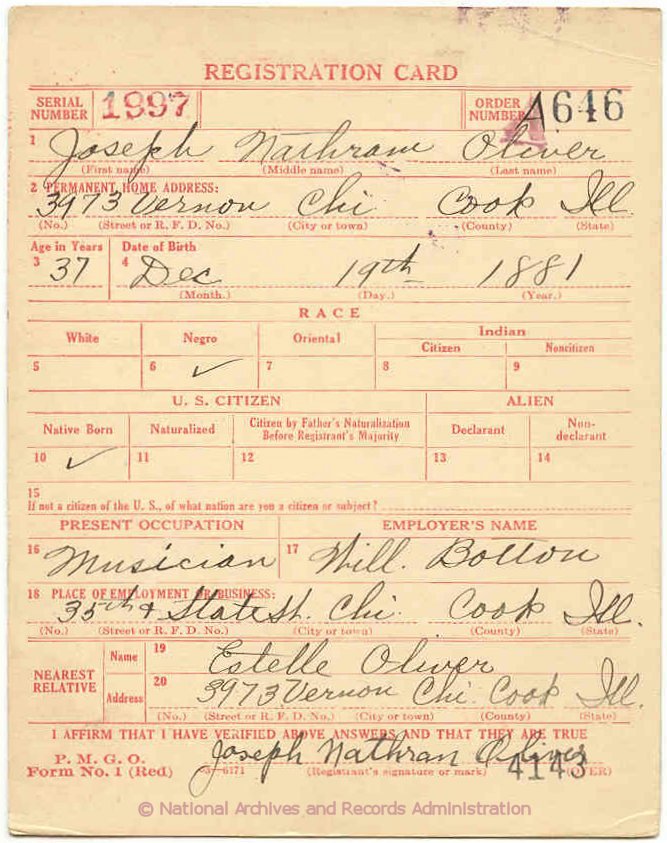
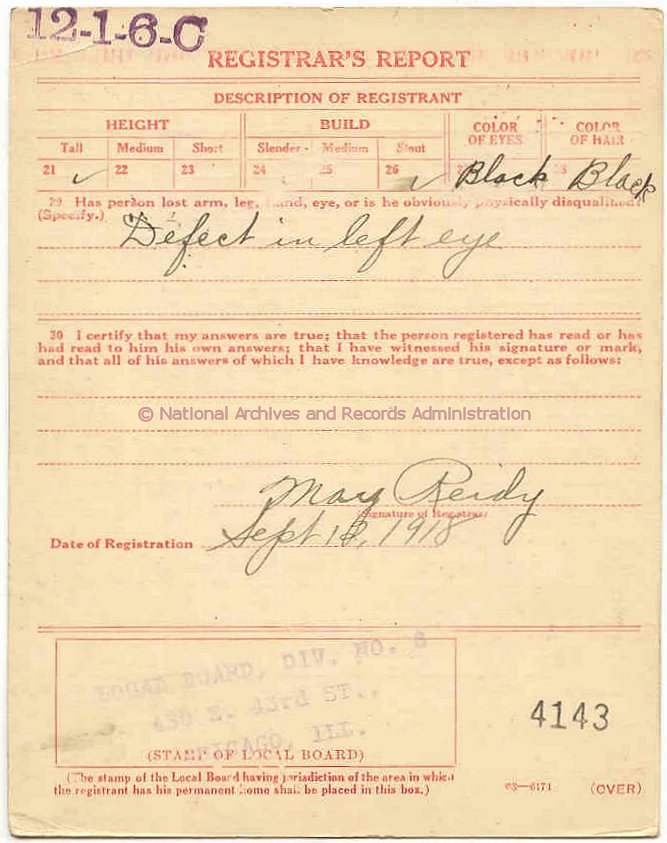
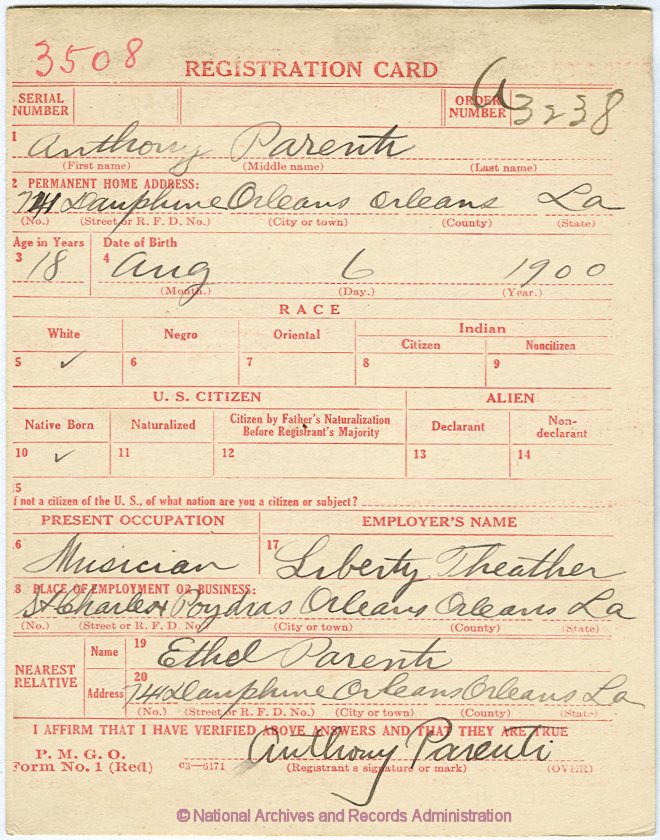
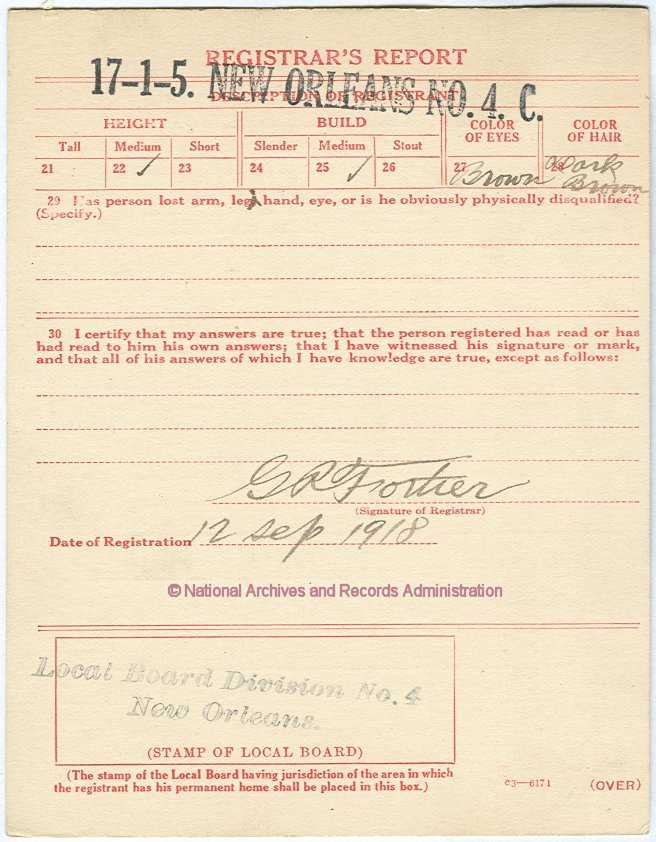
Musicians

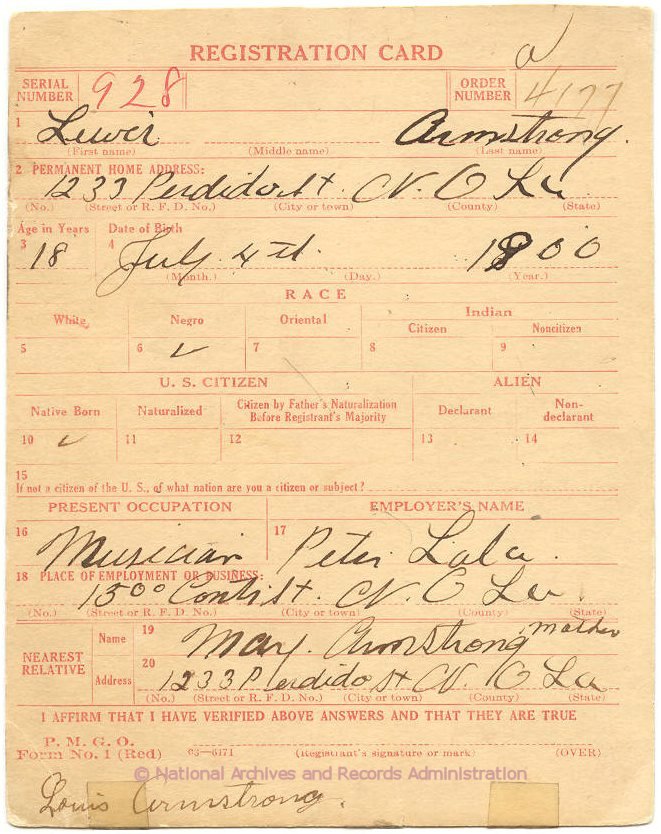
LOUIS ARMSTRONG

Click to enlarge front of WWI Draft Registration Card         Click to enlarge back of WWI Draft Registration Card

Louis Armstrong

WWI Draft Registration Card
12th September 1918

Louis Armstrong believed all his life that he was an All-American jazz boy, born on the Fourth of July, 1900. Louis was almost universally loved, and few Americans, black or white, would ever dispute his claim. As Duke Ellington pointed out, he never consciously hurt anyone along the way in a life crammed full of achievement. It was not until over a decade after his death after his death that Tad Jones (1952-2007), a music historian and writer on jazz and rhythm and blues in New Orleans, and organiser of the Satchmo SummerFest, obtained a baptismal certificate from the Archives of the Catholic Archdiocese of New Orleans, which disclosed that Louis was born on 4th August 1901. He was taken to the Sacred Heart of Jesus Church at 139 South Lopez Street, New Orleans on 25th August 1901 and, described as “niger illegitimus,” baptised by the Reverend J. M. Toohey.

Incorrectly recorded as “Lewis” Armstrong on the draft card, the registering officer was obviously ignorant of the fact that many New Orleanians and other Southerners pronounce the name “Louis” as “Loo—iss” rather than the French pronunciation of “Loo—ee.” Armstrong clearly signed the card as “Louis Armstrong.”
[PH 3]

© November 2007 Peter Hanley

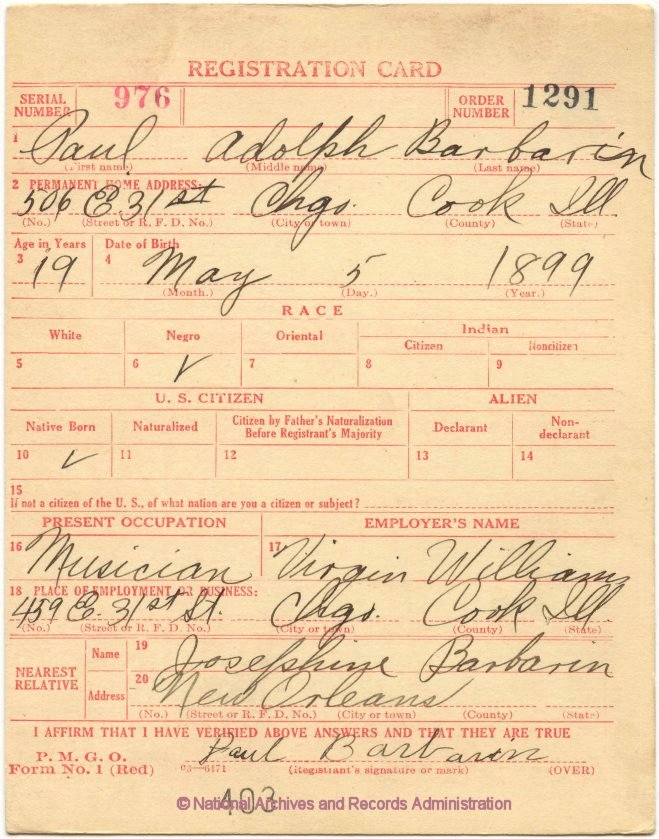
PAUL ADOLPH BARBARIN

Click to enlarge front of WWI Draft Registration Card         Click to enlarge back of WWI Draft Registration Card

Paul Adolph Barbarin

WWI Draft Registration Card
12th September 1918

Paul Adolph Barbarin, one of New Orleans’ greatest drummers, was born in that city on 5th May 1899. Previously, his birth year has been listed as 1901 by some sources (including this writer) but the draft card, above, sets the record straight.

Like many New Orleans musicians, Paul Barbarin came from a musical family. His father, Isadore, played brass instruments and a younger brother, Louis (born in 1902) became another celebrated drummer.

As a teenager he was playing drums professionally with Buddy Petit, Chris Kelly, Walter Robertson and in parade bands. He learned from listening to older New Orleans drummers such as John MacMurray, Mack Lacey and Louis Cottrell Sr. He was particularly impressed by Lacey, who he described as “a wonderful drummer; smooth, I mean clean, too. Not a whole load of noise.”

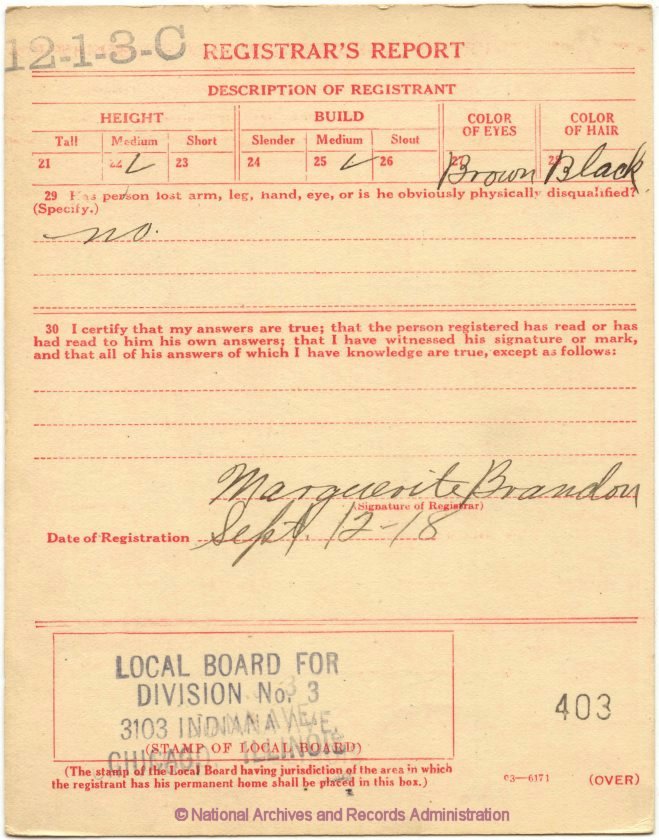
In 1917 he went to Chicago, working a “day job” in the Armour & Co. stockyards and drumming at night with a variety of bands, including those led by Freddie Keppard, King Oliver and Jimmie Noone. The draft card, dated 12th September 1918, lists Barbarin as “musician” rather than a stockyard worker. It also indicates that he was living just a few doors away from his employer, Virgin
[sic] Williams. Virgil Williams was co-owner of the Royal Gardens Café, where Barbarin played with King Oliver.

He returned to New Orleans around 1920, playing with Luis Russell at Tom Anderson’s and in a number of brass bands, before returning to Chicago in 1924. Back in Chicago, he joined King Oliver’s Orchestra in 1925. He is heard on many classic sides by Oliver’s Dixie Syncopators: “Sugar Foot Stomp,” “Wa Wa Wa,” “Too Bad,” “Deep Henderson,” “Jackass Blues” and others. During the time Barbarin was Oliver’s drummer, Luis Russell was the pianist. The bandmates co-composed the jazz classic “Come Back, Sweet Papa” which was first recorded by Louis Armstrong and his Hot Five in 1926.

He went back to New Orleans in 1927 for a short stay. Next, he relocated to New York City, taking the drum chair with Luis Russell’s Orchestra. The orchestra featured J.C. Higginbotham on trombone and three of Barbarin’s fellow New Orleanians: Henry “Red” Allen (trumpet), Albert Nicholas (clarinet) and George “Pops” Foster (bass). Russell’s 78 of “Panama” (1930) ranks as one of the hottest jazz records of all time. The superb ensembles and solos are underscored by the incredible rhythm section — Barbarin, Foster, Russell and banjoist Will Johnson. The drumming is marvelous; clean, smooth, buoyant — the same attributes Barbarin admired in the playing of older New Orleans drummers such as Mack Lacey. However, despite the finesse, he drives the performance fiercely from beginning to end. Another classic recording from this era also included Barbarin’s smooth sound: Louis Armstrong’s “Mahogany Hall Stomp.”

While a member of the Russell Orchestra, Paul Barbarin also recorded with Jelly Roll Morton. On that occasion, Morton’s Red Hot Peppers also included Allen, Higginbotham, Nicholas, Johnson and Foster. The band recorded “Sweet Peter,” “Jersey Joe,” “Mississippi Mildred” and “Mint Julep.” The drumming on these sides is, in the words of Gene Krupa, “beautiful simplicity.” Many years later, in 1939, Morton sent a letter to Down Beat magazine, listing his selections for an “All-Star Band.” The 14-piece orchestra included Allen, Nicholas, Foster — and Barbarin!

He made yet another trip to New Orleans in the early ‘30s, but rejoined Russell in New York in 1935. By then, the Russell Orchestra had become the backup band for Louis Armstrong. Barbarin appeared on many classic Armstrong recordings before leaving once again for New Orleans, in 1938. His replacement in the orchestra was none other than Sidney “Big Sid” Catlett! Still, a credible source has reported that Louis Armstrong once said that of all the wonderful drummers he had worked with, Paul Barbarin was his favorite!

He continued to use New Orleans as a base of operations, though he traveled north for short stints with Armstrong, Allen, Sidney Bechet and Art Hodes. He was the first choice for the drum chair when veteran trumpeter Bunk Johnson made his first recordings. However, Barbarin turned down the offer, fearing that he might fall afoul of the musicians’ union. Some years later he did appear with Johnson on a concert sponsored by the New Orleans Jazz Foundation. Their musical colleagues on this occasion included Louis Armstrong, J.C. Higginbotham, Sidney Bechet and James P. Johnson!

By 1954, Barbarin returned to New Orleans for good. He organized a traditional jazz band, which toured extensively and made many outstanding recordings. During this time he also composed two more jazz classics: “Bourbon Street Parade” and “The Second Line.” In addition to leading the jazz band, he also led (and played snare drum) with the Onward Brass Band. He died in 1969 while playing a parade with the Onward band.

Fortunately, Paul Barbarin left an extensive recorded legacy — with King Oliver, Luis Russell, Jelly Roll Morton, Louis Armstrong and his own groups. His drumming style was as precise, clean and swinging as the veteran drummers he admired as a youth. It should serve as model for future generations of New Orleans drummers.
  [HS 2]

© May 2007 Hal Smith

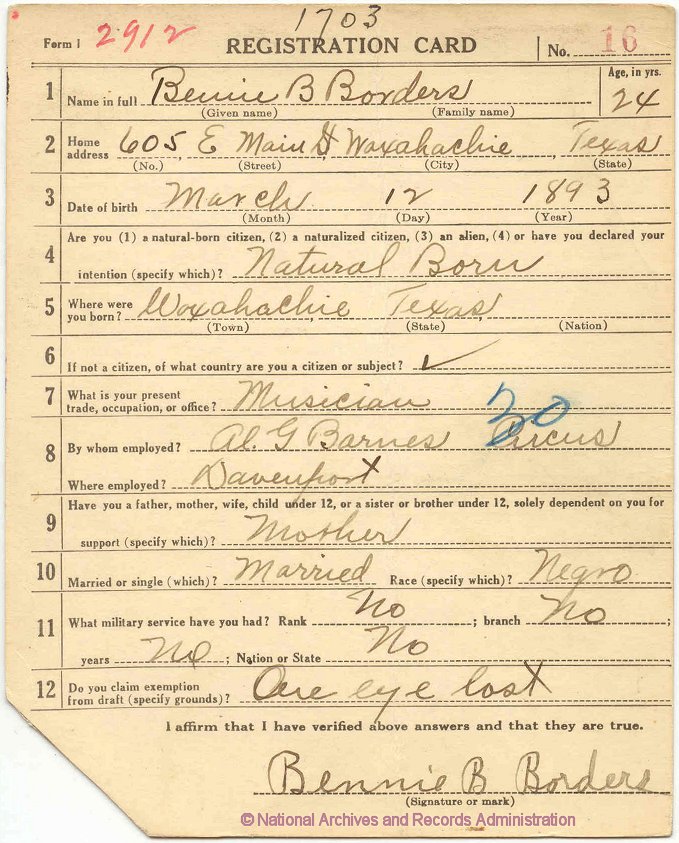
BENNIE B. BORDERS

Click to enlarge front of WWI Draft Registration Card         Click to enlarge back of WWI Draft Registration Card

Bennie B. Borders

WWI Draft Registration Card
5th June 1917

Bennie “Rhythm Ben” Borders played drums on the first commercially issued jazz recording by an African-American band, Spikes’ Seven Pods of Pepper/Ory’s Sunshine Orchestra, in 1922.

He was born 12th March 1893 in Waxahachie Texas — located in Ellis County, 30 miles south of Dallas, in the North Central part of the state. With a birth year of 1893, Borders was just one year younger than fellow jazz drummer Ollie “Dink” Johnson, but older than Warren “Baby” Dodds, Arthur “Zutty” Singleton, Paul Barbarin, Minor Hall, Fred “Tubby” Hall and Tony Sbarbaro.

The draft card indicates that at the time of registration, Borders was married, with his mother dependent on at least a portion of his income. On line 12 of the card, he claimed exemption from the draft due to “One eye lost.”

Borders registered for the draft while performing with the Al G. Barnes Circus band. In the early years of the 20th Century, circuses and “Wild West” shows provided steady, good-paying employment for African-American musicians, including Willie “Bunk” Johnson and Willis Handy Young — father of Lester.

During the late ‘teens or early ‘20s, Bennie Borders decided to settle in Los Angeles, California. There he worked with Dink Johnson’s Jazz Band (also known as the Five Hounds of Jazz), the Original Satisfied Orchestra and Ory’s Sunshine Orchestra. Coincidentally, all three groups included one of Jelly Roll Morton’s best disciples: pianist Buster Wilson.

Though Wilson worked with the Ory group, he was not present on the historic June 1922 recordings in Los Angeles for the Sunshine and Nordskog labels. Fred Washington was the pianist when Spikes’ Seven Pods of Pepper recorded “Krooked Blues,” “When You’re Alone Blues,” “Maybe Some Day” (also known as “Some Rainy Day”) and “That Sweet Something Dear.” Vocalist Roberta Dudley sang the first two titles and Ruth Lee was the singer on the second coupling, accompanied by “Papa Mutt” Carey (cornet); Edward “Kid” Ory (trombone); Ollie “Dink” Johnson (clarinet); Washington (piano); Ed Garland (bass) and Borders (drums). Following the vocals, the band recorded two instrumentals (“Ory’s Creole Trombone” and “Society Blues”) as Ory’s Sunshine Orchestra.

Bennie Borders’ drumming on these sides is typical of the ragtime-into-jazz style heard on many recordings from the acoustic era. At the time, recording engineers (especially those who worked for small labels) were still not able to capture the sounds of a full drum set. As a consequence, drummers were limited to the percussion instruments that would record clearly, without causing potential damage to fragile recording equipment. The primitive equipment was able to pick up the sound of woodblocks, rims and the shell of the bass drum with no problem. As a result, that is the most frequently-heard sound on early jazz records. On the 1922 sides, Borders plays a wonderful “toddling” rhythm on the blocks reminiscent of Baby Dodds’ recordings with King Oliver and Tony Sbarbaro’s with the Original Dixieland Jass Band.

Later in the ‘20s, Bennie Borders worked with Leon René’s Southern Syncopators. He also led his own group beginning in 1931. According to jazz historian Frank Driggs, Borders “died a few years later” — presumably in Los Angeles or nearby. However, he lived long enough to attend Jelly Roll Morton’s funeral in Los Angeles in 1941. Photographs in Driggs’ book Black Beauty, White Heat show Borders with Dink Johnson, René and a solo shot with a variety of percussion instruments (including two slapsticks labeled “Rhythm Ben”).
[BWH]  [HS 1]

© February 2007 Hal Smith

EMILE J. CHRISTIAN

Click to enlarge front of WWI Draft Registration Card         Click to enlarge back of WWI Draft Registration Card

Emile J. Christian

WWI Draft Registration Card
5th June 1917

Very few jazz musicians had such a varied career as Emile Christian. He is best known as the trombonist who replaced Eddie Edwards in the Original Dixieland Jazz Band when Edwards was drafted, and who was therefore on their 1919-20 visit to England and their English Columbia records. He returned with the band to the U.S.A. on 8th July 1920 giving the same birth date as the draft card and his address as 2538 Rampart Street, New Orleans.

According to all standard sources, Emile had two musical brothers, trombonist Charles (1886-1964) and cornetist Frank (1887-1973), who taught Emile his first instrument. However, when 15-year old Emile was enumerated in the 1910 U.S. Census at 2538 Rampart Street, New Orleans, the household otherwise contained only a sister, Eva, aged 18, and his widowed mother Christina, who told the enumerator she had had five children only two of whom were living. It must follow from this that Charles and Frank were Emile’s half-brothers. In 1910 they and their wives are sharing a household at 634 Port Street, New Orleans. Frank is described as a cornet player, Charles is a tin-worker. Emile is described as a “bundle boy” in a department store.

Emile took up the cornet shortly afterwards and played in various brass bands before setting off for Chicago. He is usually said to have gone in 1917 to join Bert Kelly’s band at the Greene Goose Club, but it seems in fact that he was already in Chicago for the engagement of Brown’s Dixieland Ragtime Band at the North Star Inn from April to October 1916. The name was changed to Original Brown’s Jass Band from Dixieland during the run. The previous year Brown’s band had been said by the Chicago Examiner to be “one of the few made up of white men which is capable of playing negro music with the proper verve and tempo.”

At the time of the draft registration, Christian was working at the Casino Gardens, a venue which a few months before had been home to the Louisville Jug Band. Unfortunately he names the proprietors rather than the bandleader as his employer. Around 1917-18, he worked with Merritt Brunies’s Original New Orleans Jazz Band, not to be confused with the Original New Orleans Jazz Band, which recorded in New York in 1919-20 with Frank Christian on cornet. Sometime during the Chicago years the trombone became his main instrument. The ODJB episode followed. Though Emile returned with them, he stayed home for only three weeks, working with Phil Napoleon and Frank Signorelli at Kelly’s at Coney Island.

“Three weeks was all I could take after a taste of Europe and back I went to London,” he said. He played with English bands in Britain and France before gravitating to Germany where he joined Tom Waltham’s Ad-Libs with whom he recorded in 1925. He is also said to have worked in Berlin and Hanover in the band led by the African-American trombonist Albert Wynn, an unlikely association for a white musician from New Orleans. He moved on to Lud Gluskin’s band, with which he recorded extensively in both Paris and Berlin in 1928-1934. By this time he was also playing both brass and string bass.

After leaving Gluskin, he mainly worked with African-American groups for the remainder of the 1930s. Leonard Feather was tactless enough to mention this to Nick La Rocca. “The expression and colour of LaRocca’s face when he was told, ‘Oh, he’s doing fine — he’s working with a coloured band,’ can hardly be imagined: for LaRocca is a typical Italian-American colour-conscious person.” Feather was also a master of understatement.

In Spring 1935 Emile played with Benny Peyton’s Jazz Kings in Switzerland, and in September joined Leon Abbey’s band as the bass player on a trip to India. He remained with the band when they returned to Paris in April 1936, through a further trip to India from October 1936 to May 1937, and subsequently in the Netherlands (1937) and Scandinavia (1938-39). Though Orkester Journalen reported at the time that he was not with the band in Stockholm this seems to be because they were looking for a trombone player! The researches of Morten Clausen have established conclusively that he was there and can be heard playing bass on their Sonora recordings of July 1938, which are Latin music rather than jazz. They did play jazz on a surviving Danish Radio broadcast in October 1938.

Unfortunately the band got stranded in Odense in July 1939 and were effectively detained while Abbey went to Paris to raise funds to pay their debts. By now war clouds were gathering and Emile was one of the musicians evacuated on the “S.S. St. John” from Bordeaux on 14th October 1939 along with Abbey, Benny Peyton, Garland Wilson, Una Mae Carlisle and many others. “We had enough musicians on board for a symphony,” said Emile, “and had a revised personnel each night. You can be sure we rocked the St. John all the way in.”

During World War II Emile worked in a defense plant, later returning to New Orleans and becoming once more strictly a segregated Dixieland player. He recorded a session under his own name for Southland in 1958. He died in New Orleans on 3rd December 1973.

[Direct quotations from Emile Christian are taken from an interview conducted at the Savoy Ballroom, New York City, shortly after his return to the U.S.A. and published in Swing Music for December 1939. It is anonymous, but was probably with editor Timme Rosencrantz.]  [HR 2]

© March 2007 Howard Rye

JEAN LAWRENCE COOK

Click to enlarge front of WWI Draft Registration Card         Click to enlarge back of WWI Draft Registration Card

Jean Lawrence Cook

WWI Draft Registration Card
12th September 1918

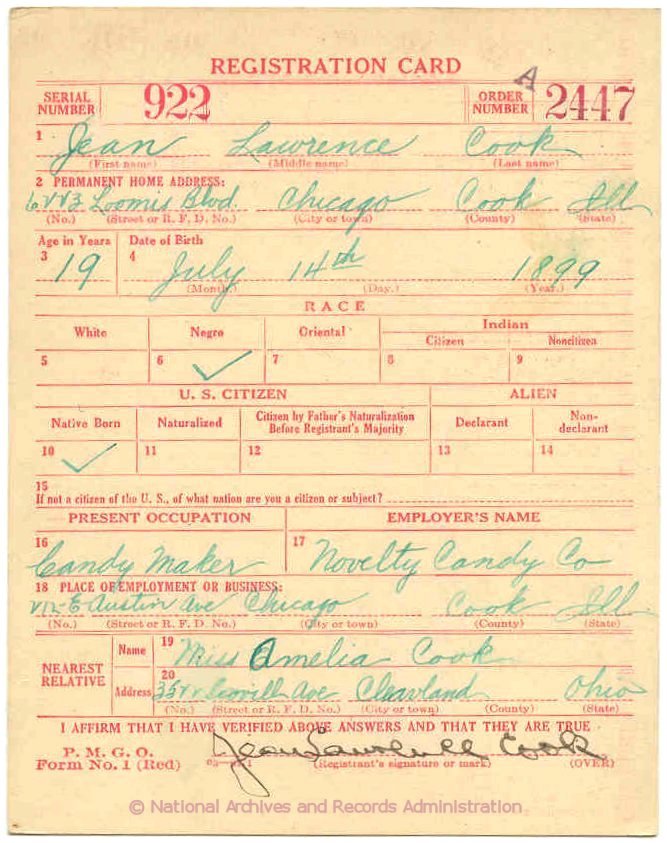
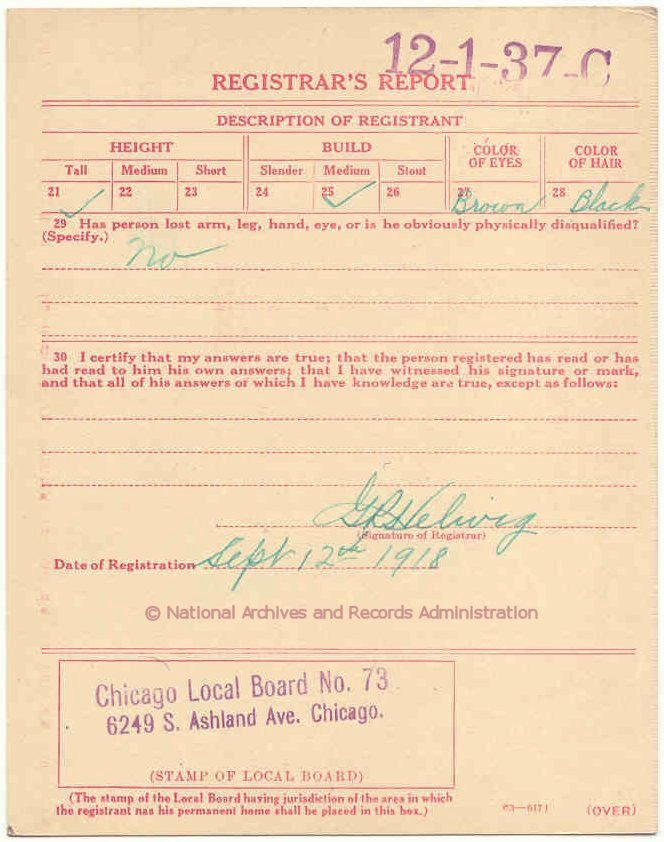
My first experience of J. Lawrence Cook’s work came when I acquired my first player piano many years ago. Included in the purchase were two “Fats” Waller QRS rolls, which greatly impressed me — so much so that they were very quickly reduced to shreds with constant playing. What I did not know at the time was that Cook had edited all of Waller’s QRS output. Having collected all the available Waller rolls, I am now firmly of the opinion that Cook’s contribution to them went much further than a simple editing job — there is at least one documented instance of ‘Fats’ starting a roll but failing to turn up to finish it, so Cook had to complete the job.

Cook was a musical chameleon — he could produce convincing keyboard impressions of Art Tatum, “Fats” Waller, Teddy Wilson, Erroll Garner and several other leading pianists of the day. However, a major part of his QRS career was spent producing arrangements of commercial pop songs, as required for the catalogue of a commercial roll producer, and it is to Cook’s credit that his unique skill injected musicality into otherwise unexceptional material.

Some of the hot jazz rolls, which appeared under his own name, particularly those released during the 1940s, are masterpieces of swing piano playing. The arrangements are superb, clearly the product of a very fertile imagination, without doubt the work of somebody with a complete understanding of the idiom. He was far and away the most prolific and successful roll artist the world has ever known — yet he was just a part-timer (both Mike Montgomery and Bob Billings have told me that Cook held down a night job with the U.S. Post Office).
[JF 1]

© March 2002 John Farrell

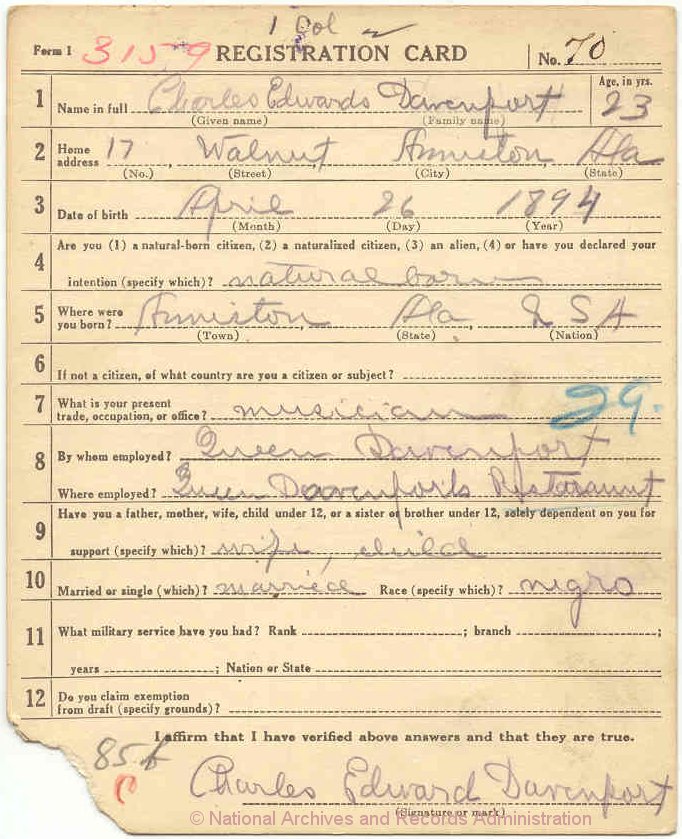
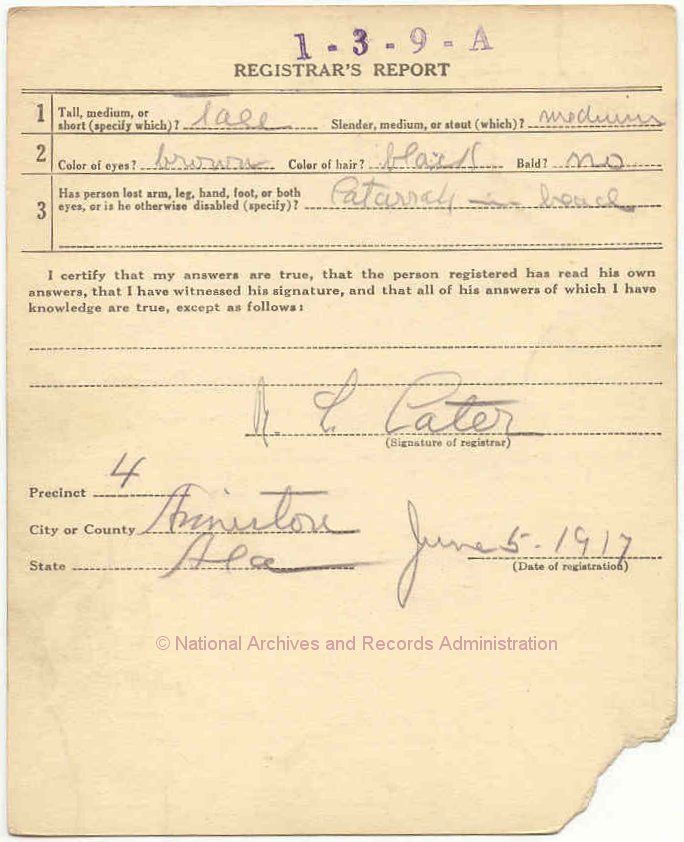
CHARLES EDWARD DAVENPORT

Click to enlarge front of WWI Draft Registration Card         Click to enlarge back of WWI Draft Registration Card

Charles Edward Davenport

WWI Draft Registration Card
5th June 1917

In the early years of the 20th century men like Charlie Spand, Charlie Avery, Leroy Garnett, Will Ezell, Montana Taylor, Doug Suggs and Pinetop Smith were evolving the blues based piano style which was to become known as “fast western” or “boogie woogie”.  Cow Cow Davenport was another such pioneer, but one whose experience in the entertainment business was greater than most.

Charles Edward “Cow Cow” Davenport was born in Anniston, Alabama on April 26, 1894. His father, Clement, a preacher, did not want him to become an itinerant musician, but there was a piano in the house on which he taught himself to play. His mother, Queen, was a pianist at the local church. Davenport said: “My mother admired me because I could play and my father
[. . . he wouldn’t let me learn music . . .] hated me because I could play . . . he wanted me to be a preacher. . . . He sent me to Selma University, a Baptist college in Alabama.” [TJR]

As a teenager he played piano in bars, brothels, local dances, parties, cabarets — wherever a job opportunity arose.  Pianist Floyd Taylor told Paul Oliver, “Charlie Davenport, which we used to call Cow Cow, was another feller that was well-known in this part [Detroit], he was always coming and going, didn’t stay too long at any one time.” [CWB]  This comment encapsulates Davenport’s wanderlust, his travels at this time also including Birmingham in Alabama, Atlanta and Macon in Georgia, and New Orleans. In his 20s he toured with Barkoot’s Traveling Carnival and, as a black-face singing and dancing minstrel, with Haeg’s Circus. Between 1922 and 1926 he toured on the TOBA circuit with singer/dancer Dora Carr, recording vocal duets with her for OKeh and Gennett. Then he joined forces with singer Ivy Smith, touring in their own “Chicago Steppers” review, again for TOBA. They recorded vocal duets between 1928 and 1929 for Gennett and Vocalion.

Davenport’s discography is of reasonable size and covers all manner of settings — piano solos, piano and vocal, vocals, comedy, piano accompaniments and band numbers, many of them his own compositions. He recorded for Paramount, cut piano rolls for QRS and Vocalstyle, and made several titles with Hound Head Henry (1928) and Sam Theard (1929/1930).
[BGR]  Davenport claimed to have written “I’ll be Glad When You’re Dead, You Rascal You”, when he was working with Sam Theard, and “Mama Don’t Allow”, recorded by Frankie ‘Half Pint’ Jaxon, but to have sold them for a flat fee, receiving no composer credit or royalties. [BWW]  He also said he wrote “Cow Cow Boogie”, which became a big hit for Capitol records and the Freddy Slack Orchestra; that Leeds Music had given him $500 for the tune and removed his name from the sheet music. [DB]  If the song was written by Davenport, then the named composer, Don Raye, must have smoothed away the barrelhouse feeling.

Around 1930 he moved to Cleveland to open a music store and this became the city to which he would return time and again. He played theatre dates during the mid-1930s with his “Cow Cow’s Chicago Steppers”. The creditors took over the bus in Florida in 1935 and the show was stranded.
[DB]  About 1937 he met and married Peggy Taylor, a snake dancer. “I got to be a spieler, with snakes. I got a cowboy hat and went on the front to talk.” The snakes were a constant problem when touring — “So many people had us arrested about those snakes. . . .”! [TJR]

“Cow Cow Blues” came to the attention of a wider audience in 1940 when it was recorded by a Sammy Price septet in March 1940.  (Davenport had recorded, as a singer, with pianist Price’s band for Decca in 1938.)  Six months later the more famous Bob Crosby orchestra followed the outline used by Price to record its big band version. (Bob Zurke’s orchestra also recorded “Cow Cow Blues”, in May 1940, but it has only a passing resemblance to the original.)  The growing interest in jazz history meant more engagements in New York — he appeared on Art Hodes radio show (1942), played a Blue Note concert at Town Hall (1945) and at the Stuyvesant Casino (1948). He also recorded piano solos for Comet in 1944, plus unissued sides in 1946 for Jazz Record (vocals with an Art Hodes band) and Circle (duets with Peggy Montez). But as he said in his 1944 interview, “I’m wandering around, trying to get some work.” [TJR]  After 1948 he had mainly non-musical jobs in Cleveland. He died in Cleveland, Ohio on December 3, 1955.

Critical comments have included, “. . . his style was primitive, driving, rough, winning by its honesty and feeling”
[Charles Fox]; [JOR]  “His recordings exhibit a ragtime rather than a blues slant and his playing was very accomplished” [Max Harrison]; [JOR]  “. . . a player of his generation played ragtime and ‘barrelhouse’ and it is the blend of these elements into the blues that is characteristic of his work. His ‘Atlanta Rag’ is pure ragtime with its vamping bass and scarce a hint of blues shading, only the crushed notes indicating the course of Negro piano styles.” . . . As a singer Davenport had a curiously broken, almost tuneless voice, ideally suited to ‘Jim Crow Blues’. His ‘Cow Cow Blues’ was his most famous recording . . . its strong train imitation was widely copied and has become a standard of the blues.” [Paul Oliver].  [CWB]  [DC 1]

© December 2006 Derek Coller

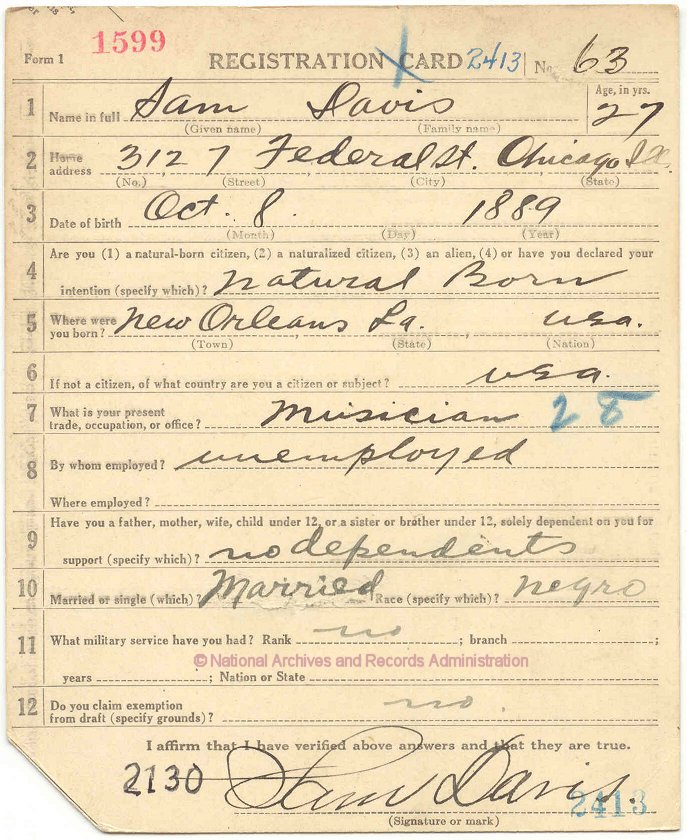
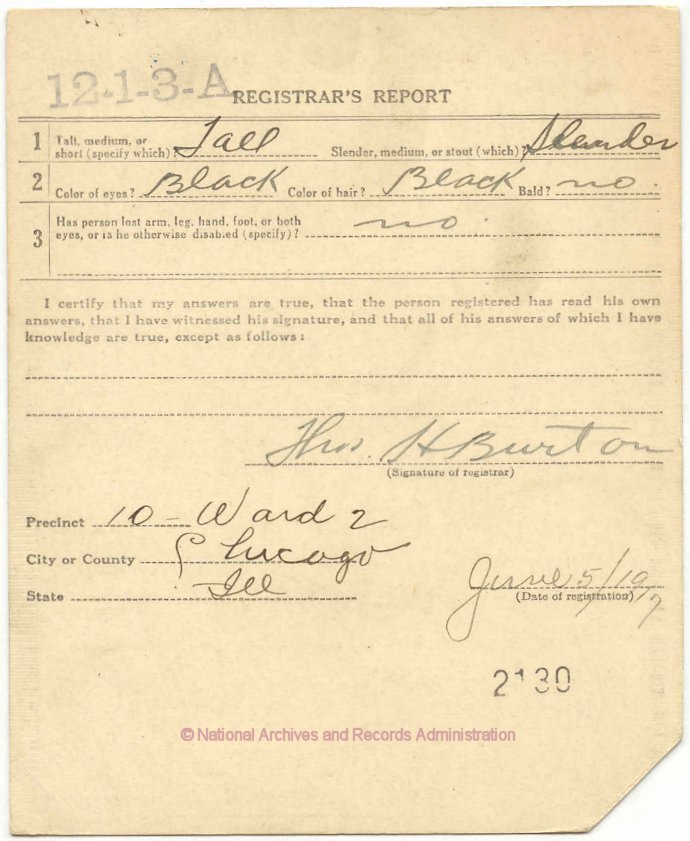
SAM DAVIS

Click to enlarge front of WWI Draft Registration Card         Click to enlarge back of WWI Draft Registration Card

Sam Davis

WWI Draft Registration Card
5th June 1917

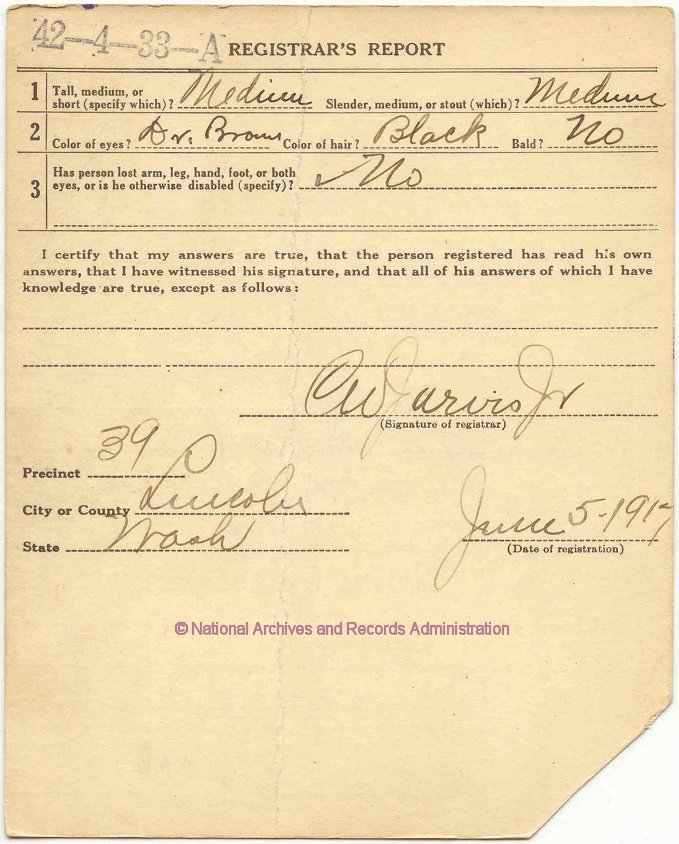
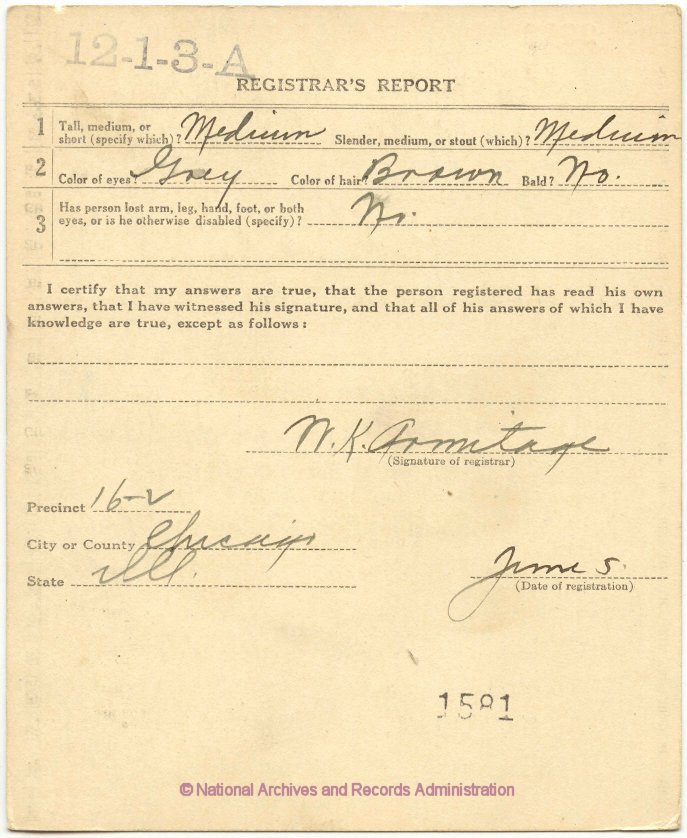
The elusive Sammy Davis, or Sam Davis as he preferred to be called, registered for the draft in Chicago on 5th June 1917, after his Storyville days were well behind him. As his draft card shows, he was born in New Orleans on 8th October 1889, the date and place also shown on his birth certificate issued in Orleans Parish.

Sam was on tour in Alabama when he was called up, so he paid his own way back to Chicago to be inducted into the Army there. If he didn’t, he was afraid he would finish up at Camp Gardner, Alabama, not a sensible choice for an African-American, even a light-skinned Creole like Sam. In the event, he was stationed at Camp Rockford, Illinois, and played in a fifteen-piece army orchestra for the duration of the war, entertaining troops and hospital patients.

Sam lived a long, but uneventful life, the last forty-five years in Albany, the State Capital of New York. Although generally neglected by jazz writers and critics alike, he was always reluctant to talk about himself and his part in the early and later days of jazz, even to the very few who interviewed him. What a wasted opportunity.
[PH 5]

© January 2007 Peter Hanley

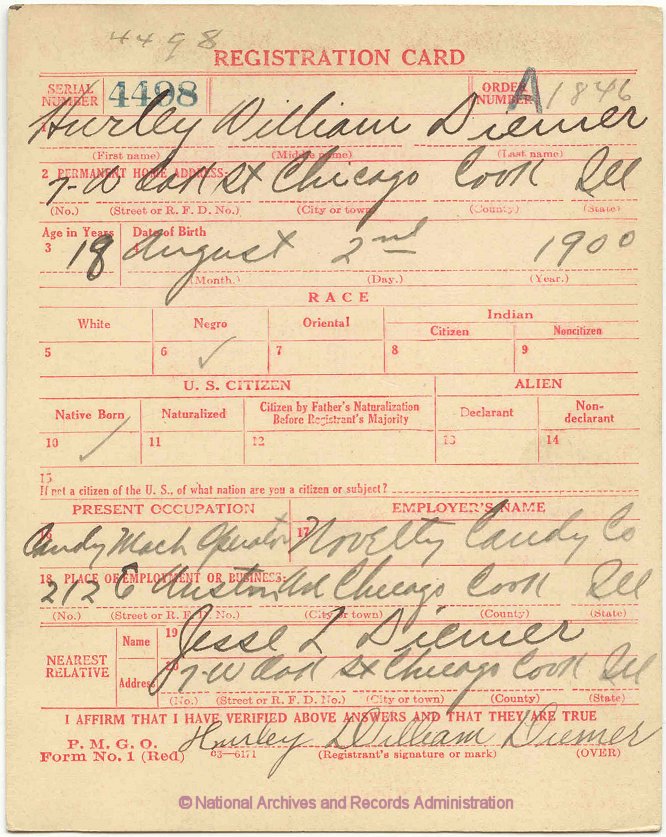
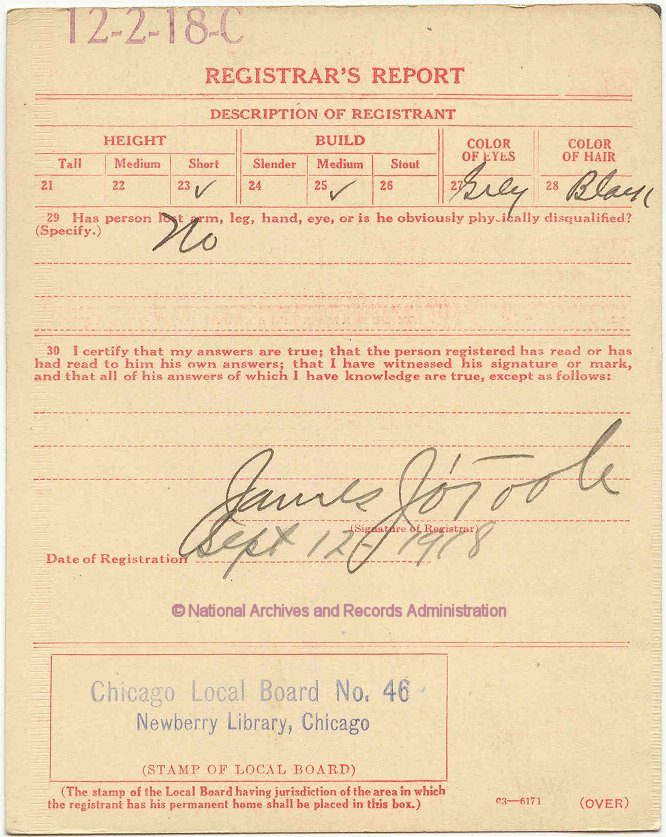
HURLEY WILLIAM DIEMER

Click to enlarge front of WWI Draft Registration Card         Click to enlarge back of WWI Draft Registration Card

Hurley William Diemer

WWI Draft Registration Card
12th September 1918

Drummer Hurley William Diemer was the youngest of the three sons of Rev. Thomas J. Diemer, born in Mississippi in August 1854, and his wife Harriett, born in Texas in January 1863, to appear in jazz discography. In fact Hurley William appears twice because it has not been realized that Hurley Diemer and William Diemer are the same musician, though this was reported many years ago by researcher John Heinz, who met him in Albany, NY, towards the end of his life. In the 1900 U.S. Census, taken before Hurley William’s birth on 2nd August, the family was living at 1034 Olive Street, Campbell Township, Springfield, Missouri. All seven survivors of the couple’s nine children were still at home. Though this information is not on the draft card, Hurley William was himself born in Springfield, according to what he told the purser of the “S.S. DeGrasse” in 1938.

The two eldest of his four elder brothers, Lee and Jesse, have no discovered musical connections. Both appear in public records as chauffeurs. However, Horace L., who was born in Springfield on 27th September 1890, and had a hat-cleaning and shoe-shining business at 20 West 35th Street, Chicago, when he registered for the draft in 1917, became a saxophonist. He recorded in 1923 with Ollie Powers’ Harmony Syncopators, a record famous and often reissued not for him but for the presence of New Orleanians Tommy Ladnier and Jimmie Noone. He remained in Chicago, where several engagements are reported during the 20s, and in 1930 was living at 4903 Forestville (recté Forrestville) Avenue, Chicago, next door to the better-known cornet player Bernie Young. His subsequent fate is unknown, but he was probably still at that address in 1938.

The next brother, Cornelius Herbert, known professionally as Herbert, was born in Lexington, Missouri on 23rd April 1896, according to his 1917 draft card, on which he is described as a “musician, not working”! He was also a saxophonist. The address which Hurley William gave when he came to register is the one at which his brother Jesse was registered the previous year. He was working at the same Novelty Candy Co. as J. Lawrence Cook at the time.

Unfortunately neither Herbert nor Hurley William has so far been traced in the 1920 (or 1930) U.S. Censuses and they are next heard of as members of the Blue Ribbon Syncopators out of Buffalo, New York. The personnel quoted for this band was obtained by John Steiner from Lloyd V. Plummer, Secretary of the Buffalo Musicians’ Association, Local 533 of the AFM, and published in the 9th August 1940 issue of Jazz Information. Plummer recalled that the band worked at Joe Niebert’s Big House, “just over the city line”. They recorded for OKeh in 1925, and again in New York City in 1927, with an enlarged and changed personnel. Both Diemers are believed to be present on both dates. This represents Herbert’s entire recording career. Plummer reported him still in Buffalo in 1940.

By July 1928, Hurley William was gone. He was a member of an act being assembled by showman Levi Wine in Zürich, Switzerland, for a European tour. The band also included reedman Roy Butler and trombonist Al Wynn. He stayed on in Europe and is reported to have worked with the singer Zaidee Jackson. He next made his mark in history when he joined Freddy Taylor’s Swing Men from Harlem to open at the Villa d’Este in Paris in about November 1934. In March 1935, at the instigation of Hugues Panassié, they made a justly revered recording for Ultraphone coupling Blue Drag and Viper’s Dream, titles which in later years have excited seekers after drug references! The African-Argentinian guitarist Oscar Alemán plays guitar on these but tests also exist from another session, probably not for Ultraphone despite Charles Delaunay’s apparent recollection, on which the guitarist may be Django Reinhardt. Unfortunately only one of these four tests has so far been issued. Django certainly played with them at the club in March-April 1935.

This engagement ended suddenly in the summer of 1935 when three members of the band were poached by violinist Leon Abbey for a band he was taking to India. Diemer seems to have remained at the Villa d’Este, where the band was now led by trumpeter Bill Coleman under whose leadership he recorded for the last time in January 1936. What he did is undiscovered but it is definite he stayed in France until 9th June 1938 when he sailed from Le Havre on the “S.S. DeGrasse” for New York City, arriving on 17th June. He gave his address as 49103 Forrest Hill Avenue, Chicago, an address which I am assured (by Neil Tesser) has never existed, and is evidently just the French purser’s version of the 4903 Forrestville Avenue address at which Horace was living in 1930.
[DFS]

He evidently soon moved to Albany, where he was living by 1940. In 1949 he was working at Gainors in nearby Troy. When John Heinz interviewed him in the late 40s he spoke derogatively about Jelly Roll Morton, apparently as a result of a gig for which Jelly had employed a local band at the University Club on Pearl Street, Albany “about ten years before” from which Jelly decamped on the Saturday night without paying the musicians. [JGH]  [MWS]

He died there on 2nd July 1956. The Troy Record of 18th July 1956 (courtesy of Ray Astbury), under the heading “Albany Man, 68, Indicted for Manslaughter”, tells the sorry tale: “An Albany county grand jury yesterday indicted Fred Hall, 68 on a charge of first degree manslaughter in the shotgun slaying of William H. Diemer, July 2. Police previously had charged Hall with first degree murder. The grand jury decided, however, that Hall fired “in the heat of passion” and that the slaying was not premeditated. Diemer, 56, an employe [sic] of a dry cleaning plant and a part-time musician, was killed by a blast from a 12-gauge shotgun in the hallway of a rooming house where the two lived. Police said the men, both Negroes, had been drinking and had argued.” John Heinz, who had left Albany by then, was told the argument had been about music. [DFS]  [HR 4]

© November 2007 Howard Rye


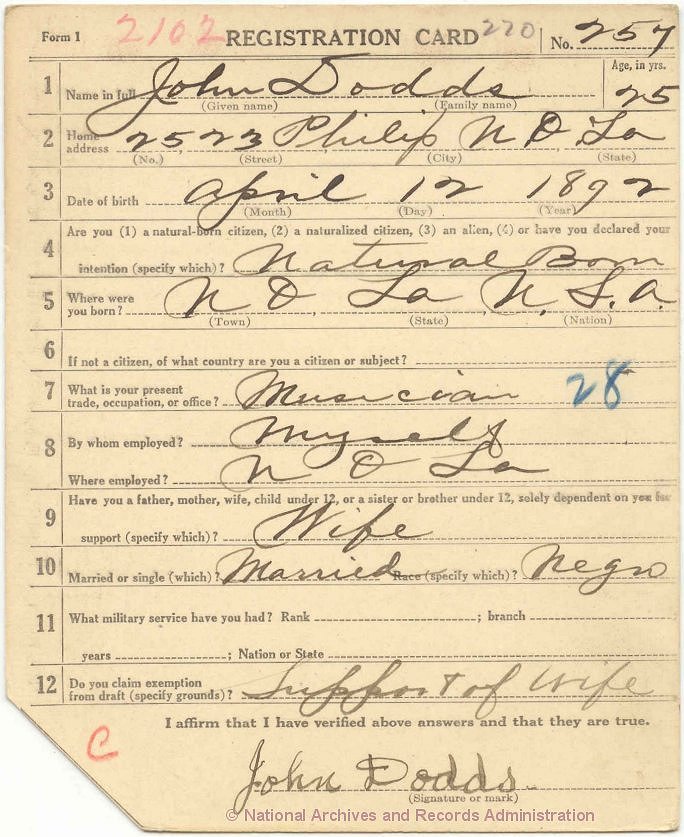
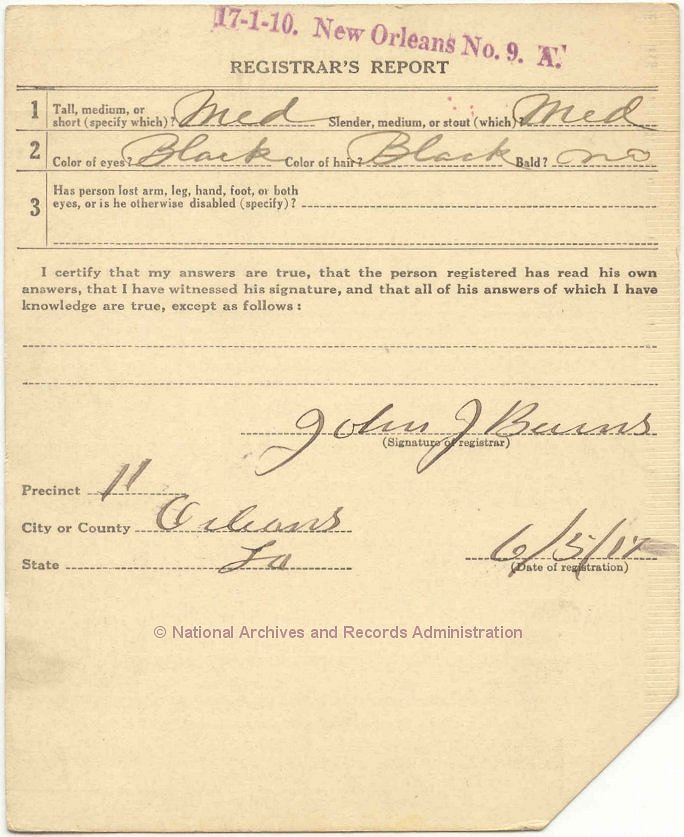
JOHN DODDS

Click to enlarge front of WWI Draft Registration Card         Click to enlarge back of WWI Draft Registration Card

John Dodds

WWI Draft Registration Card
5th June 1917

John Dodds was born in New Orleans, Louisiana on 12th April 1892, as noted on his WWI draft card. His 1900, 1920 and 1930 U.S. Census entries, and his marriage record from 26th May 1915 support this date. (New Orleans, Louisiana Marriage Records Index, 1831-1925, Volume 37, page 620)  While the location of his birth is all but certain, he gave Alabama (where his parents originated from) as his place of birth in the 1920 U.S. Census and California in the 1930 U.S. Census, while John Chilton gives Waverley, Louisiana. [WWJ 95] In addition, it has also been suggested that he was born in Waggaman, Jefferson Parish, Louisiana, which is over the river from New Orleans, and now part of the Greater New Orleans Metropolitan District. His younger brother Warren Dodds Jr. (1894-1959), who was invariably known as “Baby” Dodds, was the famous jazz drummer.

Johnny Dodds was a relatively late starter, taking up the clarinet aged 17. His father bought the horn for him, after he was making good music on a tin flute, which he had received as payment from a rag and bone man, for whom he worked. He was influenced by Sidney Bechet and took lessons from one or more of the Tio family of clarinet teachers, probably Lorenzo Tio Jr. (accounts vary), and also from Charlie McCurdy.
[BDS 3-4, 14]  He started working professionally for Kid Ory around 1911 and apart from spells with other leaders, including Fate Marable, he stayed with Ory until 1917. He then toured with vaudevillians “Billy and Mary Mack’s Merrymakers Show” and returned briefly to Ory’s band in 1919, before joining King Oliver’s Creole Jazz Band in Chicago. The band went to California in the summer of 1921 for nearly a year, and on returning to Chicago, they were resident at the Lincoln Gardens. Both Dodds brothers left the band in 1924 due to a dispute over money. Johnny subsequently worked for Freddie Keppard at Bert Kelly’s Stables and assumed the leadership of this group shortly after.

Johnny Dodds recorded regularly during the 1920s and was one of the most soulful musicians ever to appear on record. His discography speaks for itself. The clarinettist was a party to the three groundbreaking series of Jazz band recordings in the 1920s. He played on the majority of the 1923 King Oliver’s Creole Jazz Band records, all of the first group of Louis Armstrong’s Hot Five and Hot Seven sides from 1925-1927 and Jelly Roll Morton’s Victor sessions of the 4th and 10th June 1927.
[RHP] This was in addition to scores of vocal accompaniments and combo recordings, including sessions with the virtuoso ragtime blues guitarist Blind Blake, pianist “Kansas City Frank” Melrose and the Dixieland Jug Blowers.

He was a fine clarinettist in all registers and he displayed a level of expressiveness matched by few, before or since, on record. His solo on “Dippermouth Blues” with Oliver has been played practically note for note in most subsequent versions. “Perdido Street Blues” and “Too Tight” with the “New Orleans Wanderers” remain classics today, and he shone on all of the Morton sides. Dodds and Armstrong worked very well together, in sessions under either musician’s leadership, and little else needs to be said about the Hot Fives/Sevens. He also played the alto saxophone from time to time. However, Baby and trumpeter Natty Dominique, who regularly worked with him from 1928 until 1940, used to rile him about playing it until he got angry, and Dominique used to call his sax “the secret weapon”! Baby Dodds also noted that his brother was a good reader and that he used to sometimes play violin parts on the clarinet.
[BDS 52-55] This makes sense, because while he primarily worked in a small band setting featuring improvisation, he would have needed to read adequately to have worked with Fate Marable, who actually fired Louis Armstrong for not getting up to speed on his reading skills.

Dodds was a levelheaded, industrious man. His house was a three-story apartment building at 39th and Madison in Chicago. Also, even though he did not drive himself, both he and Baby had a taxi business with their older brother Bill (born September 1889), who was a mechanic. Dodds was usually abstemious and while he was not a strict teetotaller, he was always extremely temperate as his son, John Jr., noted that he only drank a little beer. As a bandleader, Baby Dodds recalled that his brother was “a pretty stiff fellow” who was quite strict and he did not tolerate tardiness, sloppy posture or smoking on the bandstand.
[BDS 53] The clarinettist judged people by his own standards and he expected musicians to play to the best of their ability, while being well presented. The Dodds brothers were in possession of quite different temperaments, and apparently they quarrelled regularly, even on the bandstand, but they were very close and worked well together.

Work probably slowed down temporarily for the clarinettist at the start of the great depression, as his 1930 U.S. Census entry gives his occupation as a tailor. Tragically, his wife Bessie (née Munson), died aged about 36 from heart trouble on 24th September 1931.
(Certificate No. 6027492, Illinois Statewide Death Index, 1916-1950) Several years later, he married his second wife, Georgia, who survived him. The clarinettist led his own bands at various residencies in Chicago in the 1930s. He made his only trip to New York in 1938; where, after a nine-year break, he recorded again. In the summer of 1939, he suffered a stroke that left him in a critical condition with a low chance of survival. [DB 71939] Following six months of recuperation, he held a residency at the 9750 club from 20th January until 18th March 1940, except for a few weeks off due to dental problems. His last recordings were a coupling made on 5th June 1940 for Decca under the name “Johnny Dodds and his Orchestra.” The line up consisted entirely of musicians who hailed from New Orleans or the surrounding areas. Unfortunately, two months later Johnny Dodds suffered another stroke and died aged 48 on Thursday, 8th August 1940. (Certificate No. 0023158, Illinois Statewide Death Index, 1916-1950) [DB 1581940]

As a tribute to his old friend, Sidney Bechet recorded his own composition “Blue, For You Johnny” with his “New Orleans Feetwarmers” on 6th September 1940. Baby Dodds was present on drums and there are two takes of the tune; a vocal version, featuring singer and actor Herb Jeffries (1911- ), in addition to a second instrumental one. Despite his early death after spending most of the 1930s in relative obscurity, and a recording career that essentially spanned only six years, Johnny Dodds will always rightly be remembered as one of the most original and greatest of all jazz musicians. [BG 14]

© October 2008 Brian Goggin

WARREN DODDS

Click to enlarge front of WWI Draft Registration Card         Click to enlarge back of WWI Draft Registration Card

Warren Dodds

WWI Draft Registration Card
5th June 1917

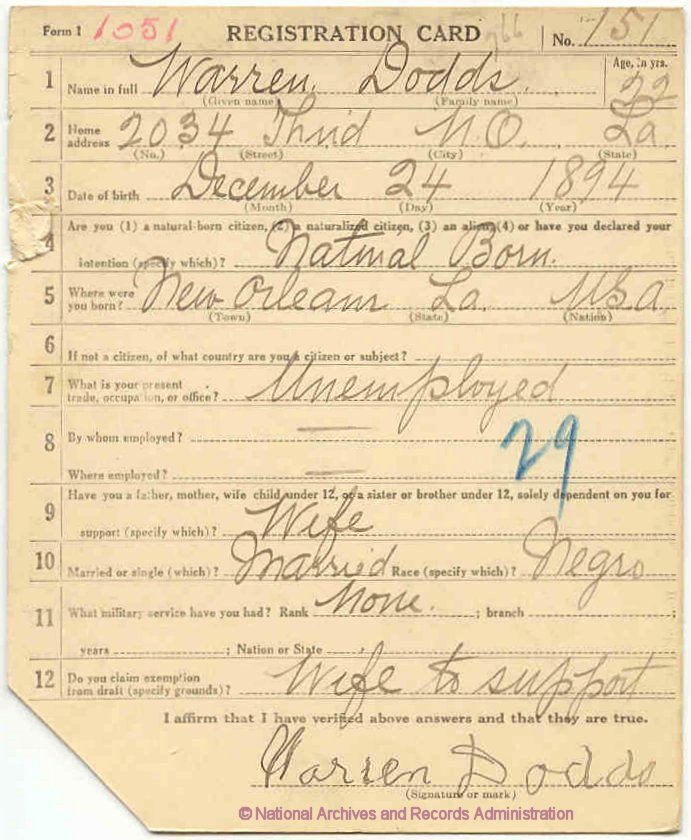
The Draft Registration Card for New Orleans-born Warren Dodds confirms the date of birth of December 24, 1894 he gave to biographer Larry Gara in 1953. [BDS 4]  Lacking his birth certificate, most writers cite 1898 — yet U.S. Census information (held by Peter Hanley) supports an earlier date. Warren, the fifth of six children, was named after his father, but his mother called him ‘Baby’. The name stuck. It was a musical family and brother Johnny (born 12th April 1892) was an accomplished clarinettist when Warren took basic drum lessons from Dave Perkins and studied theory with Walter Brundy. His first music job was with Willie Hightower c. 1912. He worked with bands led by Manuel Manetta, Frankie Duson and Oscar Celestin, and in parades with Bunk Johnson. From autumn 1918 until August 1921 Baby played in Fate Marable’s star-studded orchestra on the Mississippi riverboats.

In May 1921 King Oliver’s band (with Johnny Dodds) went to California and Baby joined in September. Shortage of work early in 1922 forced most of the musicians back to Chicago. Joe Oliver, Johnny and Baby stayed, returning to Chicago in June 1922 for the long Creole Jazz Band residency at the Lincoln Gardens. Oliver brought Louis Armstrong from New Orleans, and the rest is history. In late 1923 the Creole band broke up. Johnny and Baby Dodds stayed at the Lincoln Gardens while Oliver toured, and on his return mid 1924 moved their group into Burt Kelly’s Stables. Baby Dodds also worked with other bands and recorded extensively during the 1920s. In 1926, while in Chicago, Jelly Roll Morton formed the Red Hot Pepper Victor recording band, using mainly New Orleans musicians. The genius that was Morton — and the superlative musical and recording quality of the first Red Hot Peppers records — ensured a return to the Victor studios in June 1927, where Johnny and Baby Dodds featured on historic band and trio sides.

Kelly’s Stables closed in January 1930 and for ten years Johnny Dodds, with Baby, organised small groups. Times were tough and c. 1935 they became non-driving partners in brother Willie’s cab business. Johnny Dodds suffered a stroke in 1939 and subsequent ill health forced him into semi-retirement. On 8th August 1940, following another stroke, he died. Baby lost his brother and long-time musical partner. Jazz lost a remarkable pioneer. Baby then freelanced in Chicago’s clubs, dancehalls and taverns and worked with Jimmie Noone.

The ‘rediscovery’ of Bunk Johnson in September 1938, his correspondence, recordings and San Francisco exploits have been well documented. In July 1944 and May 1945 Baby Dodds was invited, at Bunk’s request, to record for American Music in New Orleans. While there he recorded with others, and these definitive Bill Russell discs brought Bunk and Baby to a wide audience and international acclaim. In September 1945 Baby made his first trip to New York for Bunk’s Decca and Victor sessions and an engagement at the Stuyvesant Casino. He also recorded separately for Blue Note and Circle before returning to Chicago and New Orleans for more Circle recordings.

Baby was back in New York in January 1947 for Rudi Blesh’s This Is Jazz weekly radio series and was on most of the 35 broadcasts. During his year in New York he played concerts, clubs and recorded with the Mezzrow-Bechet quintet and groups led by Mutt Carey, Art Hodes and Tony Parenti. He went to France with a Mezzrow group in February 1948, and in Chicago in late 1948-March 1949, played a long residency with Miff Mole.

In 1949 Baby alternated between Chicago and New York, but three strokes during 1949-1952 left him partially paralysed. He reluctantly retired in 1957, but another stroke in September 1958 left him semi-invalid. He died in Chicago on 14th February 1959. Warren ‘Baby’ Dodds remarkable life spanned jazz history from its early beginnings to the 1950s revival.
  [BH 1]

© February 2007 Bill Haesler


ANATIE DOMINIQUE

Click to enlarge front of WWI Draft Registration Card         Click to enlarge back of WWI Draft Registration Card

Anatie Dominique

WWI Draft Registration Card
5th June 1917

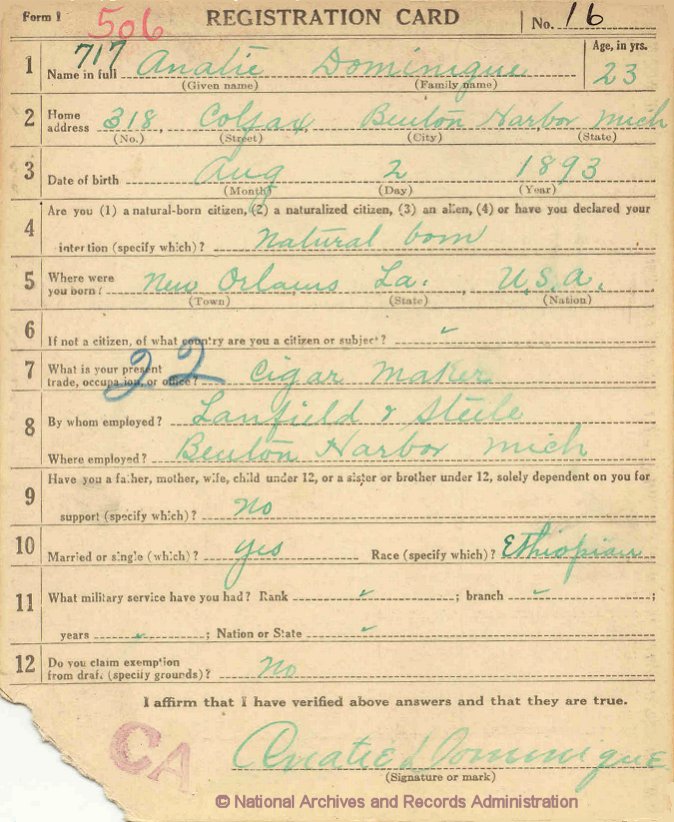
Anatie Dominique registered for the World War I draft in Benton Harbor, Berrien County, Michigan on 5th June 1917. The draft card gives his occupation as a cigar maker and his date of birth as 2nd August 1893. The 1900 U.S. Census places his birth a year later, in August 1894, while the 1910 census is consistent with the draft card and gives his occupation as a stock boy in a cigar factory. The later birth date is also given in his Social Security Death Index entry. Anatie’s older brother Ferdinand, who was born in August 1877, was also a cigar maker. Ferdinand’s son, Albert Dominique, was the well-known bandleader who worked under the name “Don Albert”. The Dominique brothers were cousins of clarinettist Barney Bigard.

Dominique grew up in a Creole household on Urquhart Street, New Orleans. He was invariably known as “Natty”. Both of his parents and his brother Ferdinand were capable singers. His sister played the piano, while another brother played the violin and took lessons on the instrument from bandleader Armand J. Piron. The family appreciated Opera and young Natty used to go to the French Opera House. He started off on the drums as a youth, inspired by hearing Louis Cottrell playing with Manuel Perez’s Orchestra. He took lessons from Cottrell and his first job involved substituting for the drummer in Perez’s band. However, he quickly gave up the drums after having trouble transporting them back from this engagement. Shortly afterwards, Manuel Perez took him under his wing with a view to teaching him the cornet. Perez initially had him sing parts and then taught him the cornet, which Dominique greatly appreciated.
[NOS 140-144]

Dominique subsequently did some parade work in New Orleans, before moving to Chicago in 1913. Initially, he worked as a cigar maker, and then he resumed playing professionally. The Creole musicians generally had a trade in addition to their music skills, which they reverted to when musical employment was not available. Natty Dominique was no exception and he took great pride in this work also. He subsequently moved to Michigan and returned to Chicago in the early 1920s, where he settled.

Natty Dominique made his first record, Some Day Sweetheart coupled with London Blues, in Chicago with Jelly Roll Morton in October 1923.
[JRB]  He recalled Zue Robertson on the date, “a great trombone player, but a very nervous guy. That guy used to lift his pants leg up so high sometimes I’d think he had short pants on.” Dominique subsequently toured with Morton through Iowa, Wisconsin and Michigan. [NOS 159] The trumpeter worked for several other Chicago bandleaders during the 1920s and he mostly played in bands led by Johnny Dodds from 1928 until the great clarinettist’s death in 1940. Shortly after, a heart condition enforced Dominique’s retirement from music and he then became a redcap at Chicago’s Midway Airport. With his storytelling and engaging personality, Dominique was said to be the most popular of the redcaps during his service there. [CMA 140]

He appeared at a Chicago jazz concert in March 1949 and resumed part time playing in the 1950s, leading his own bands. [WWJ 95] The trumpeter continued to appear with decreasing frequency until the 1970s. Natty Dominique died in Chicago on 30th August 1982.

Natty Dominique appeared on many small group records in the 1920s and 1930s. His style was in the New Orleans tradition, and he usually complimented the Dodds brothers adequately. Unfortunately, some commentators were not very enamoured with his tone, and they seemed to focus on his less capable performances. He was a straight talker and while some people felt the sharp edge of his tongue, he was forthcoming with praise for those he appreciated. Baby Dodds recalled him as being, “a very nice leader” who was not particularly strict and, “one conscientious guy.” He also recalled that the trumpeter was good at transposing.
[BDS 55] Their friendship and mutual respect remained intact permanently. In 1951, when Baby’s co-ordination had been severely compromised by two strokes, Dominique billed his band as playing “slow drag” music, specialising in tempos where Dodds could still play well. He also kept Jasper Taylor on standby in case the drummer was unable to play due to his condition. Baby Dodds mused that, “Nobody but Natty Dominique would have done something like that.” [BDS 95]  [BG 12]

© April 2008 Brian Goggin

FRANK DUSON Jr.

Click to enlarge front of WWI Draft Registration Card         Click to enlarge back of WWI Draft Registration Card

Frank Duson Jr.

WWI Draft Registration Card
12th September 1918

The legend of Frankie Duson was immortalised by Jelly Roll Morton when he sang the last verse of Buddy Bolden’s Blues for General Records in New York on 16th December 1939:

Thought I heard Frankie Duson shout,
Gal gim-me that money, I’m gonna beat it out.
I mean gim-me that money, like I explain ya, I’m gonna beat it out,
‘Cause I thought I heard Frankie Duson say
.

Behind the legend, however, there was a real person who played a part in the evolution of jazz music in New Orleans. Previously relying on the recollections of old musicians, census and other public records are now available to replace much of the legend with fact.

As Jelly Roll’s lyrics imply, Frank Duson was a ladies’ man. Al Rose wrote that Jelly Roll told him that, “Pimpin’ was his main line of work. He just played music to stay close to the action.”
[IRJ 238-9]  But play music he did, and he was remembered as a competent musician on both valve and slide trombone. He took over Buddy Bolden’s band in 1907, when it became known as the Eagle Band. Bunk Johnson said he joined the Eagle Band under Frank Duson in 1910 and played with them until he left New Orleans in 1914.

According to his draft card, Frank Duson was born on 26th July 1878, making him one of the oldest of the early New Orleans musicians. The entries for him in the U.S. Census records give varying birth years: 1873 in 1910, 1880 in 1920, and 1887 in 1930. Although the draft card does not say so, he was almost certainly born in New Orleans. His father was Frank Dusson, a barber in New Orleans, and his mother was known as Mary Listando. The surname of the family was originally spelled in the French way, Dusson, although later changed to Duson, which is quite common in Louisiana. Frank’s ancestors may have come from Duson, a small town in Lafayette Parish, which is located in the central part of southern Louisiana.

Although based in New Orleans, Frank Duson also played in New Iberia with his band. He had a girlfriend there by the name of Lila (or Lillia) Williams, who also played piano in his band, and was known as Lila Duson. Lila played on the vaudeville circuit in the south for many years. The 1910 U.S. Census has two entries for Frank, one in New Iberia living with Lila, and the other in the 12th Ward in New Orleans living with his other wife, Beatrice. There are surviving photographs of Frank and Lila from this period. No marriage records are recorded for Frank in the Orleans Parish Marriage Records up to 1925.

Frank Duson left New Orleans with Buddie Petit in late 1917 to play in an orchestra organised by Jelly Roll Morton and Dink Johnson in Los Angeles. Their sojourn on the West Coast was short lived. After a dispute with Jelly Roll and Dink, they headed back to their home territory. Neither Frank Duson nor Buddie Petit ever recorded.

Always listed in the census records as a professional musician, Frank married a much younger woman in the 1920s by the name of Ethel. The 1930 U.S. Census records them as having two daughters, Bertha, born about 1923, and Thelma, born in 1929. Frank Duson is said to have died in New Orleans on 1st April 1936, but there is no listing in the Orleans Parish Death Records under that name. There is a record of a Frank Duson dying on 14th March 1932, but it must have been Frank’s father, as his age was recorded on the death certificate as 74 years.
[PH 13]

© February 2007 Peter Hanley

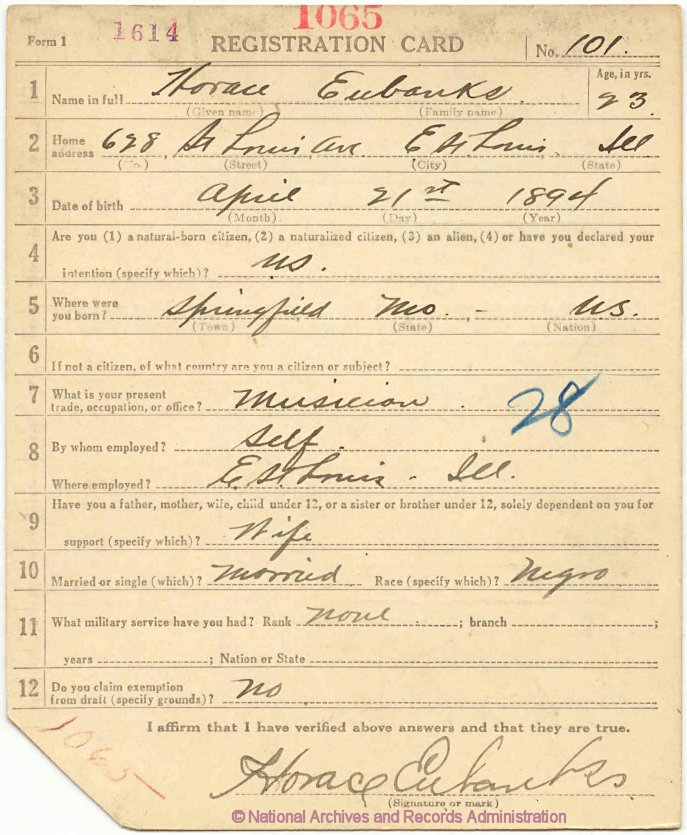
HORACE EUBANKS

Click to enlarge front of WWI Draft Registration Card         Click to enlarge back of WWI Draft Registration Card

Horace Eubanks

WWI Draft Registration Card
5th June 1917

Horace Eubanks worked with Jelly Roll Morton in 1920-21 in the Pacific North-West, including Vancouver, and again in Chicago around 1923, when he recorded with him for OKeh and was a member of the shadowy Morton-Handy Band recalled in the 1946 Esquire’s Jazz Book. [EJB 21]

Born in Springfield, Missouri, on 21st April 1894, as indicated on the draft registration, though the year is given as 1895 on his death certificate, the six-year old Horace was by January 1900 living at 628 St. Louis Avenue, Centerville Station Township in St. Clair County, Illinois. The family enumerated there in the 1900 U.S. Census comprised his father John, who was a grocery salesman born in Missouri in October 1873, his mother Belle, born in Illinois in September 1873, brothers John (4) and Francis (1) and sister Lillian (2). Also present was his aunt Annie Eubanks, who was 15. The census confirms Missouri as Horace’s state of birth though his younger siblings were all born in Illinois, where Horace was previously thought to have been born. In the 1920 U.S. Census family members were still at this address. Centerville had been incorporated in East St. Louis and father John was now divorced.

Horace, himself, as we know, had moved to the North-West and was a member of AFM Local 458 at Seattle when he traveled with Jelly to Vancouver. Between 1921 and 1923 he returned east. In Chicago he also worked with Doc Watson’s band before returning in 1925 to St. Louis, where he worked and recorded (November 1925 and May 1927) with Chas. Creath’s Jazz-O-Maniacs. It must have been shortly after the second session that he returned again to Chicago, where he led his own Dixie Strutters and worked with the violinist Wilson Robinson.

In 1928 Horace left for Europe to join Benny Peyton’s Famous New Yorkers. He was with them in Brussels in June 1929 and in Budapest in the fall. He is thought to have worked with Noble Sissle in Paris in that year. He also reportedly worked in Europe with Glover Compton and Willie Lewis.

In October and November 1933 he was a member of the band led by the Surinamese saxophonist Lex van Spall at La Gaité in Amsterdam, which also included Johnny Dunn and Jake Green. He is believed to have been in Freddy Johnson’s orchestra when they opened in The Hague in March 1934, and was certainly with them at the Pschorr Dance Hall in Rotterdam in May, playing clarinet and third alto sax. This was the last gig of his six-year European trip.

Eubanks returned to the U.S.A. on the “S.S. Bremen” from Cherbourg on 18th August 1934, arriving in New York City on the 23rd. He gave his intended address as 413 Bowen Avenue, Chicago, where he joined Carroll Dickerson’s band. For most of 1935 he was a member of Zutty Singleton’s band, recording with them for Decca in March.

In 1936 he returned to East St. Louis, where he worked with Fate Marable and Charles Creath. Horace died in the St. Louis City Sanitarium on 21st November 1948. He had been suffering from paresis, the cause of death, for 10 years. The death was reported by his son John Eubanks, Jr.
[DDC 1]  [HR 3]

© March 2007 Howard Rye


WALTER S. FARRINGTON

Click to enlarge front of WWI Draft Registration Card         Click to enlarge back of WWI Draft Registration Card

Walter S. Farrington

WWI Draft Registration Card
5th June 1917

Walter S. Farrington was born 16th November 1892, as indicated on his World War I draft card. He registered on 5th June 1917 in his home city of St. Louis, Missouri. The 1900 U.S. Census is in agreement with the year of his birth, but gives the month of birth as October. The 1910 U.S. Census lists his occupation as a porter in a barbershop, and the 1920 U.S. Census records him as a musician. Both of these Census entries note his age to be approximately one year younger.

On the Library of Congress recordings Jelly Roll Morton mentions a “newcomer” pianist called Walter Farrington, who he met in St. Louis around the early part of 1912.
[AFS 2487-B]  Prof. Lawrence Gushee suggests that Morton’s arrival in St. Louis probably occurred in February 1914. [SLPD]  “For a time I had been working with McCabe’s Minstrel Show and, when that folded in St. Louis, I began looking for a job. My goodness, the snow was piled up till you couldn’t see the streetcars.” [MJR 147]

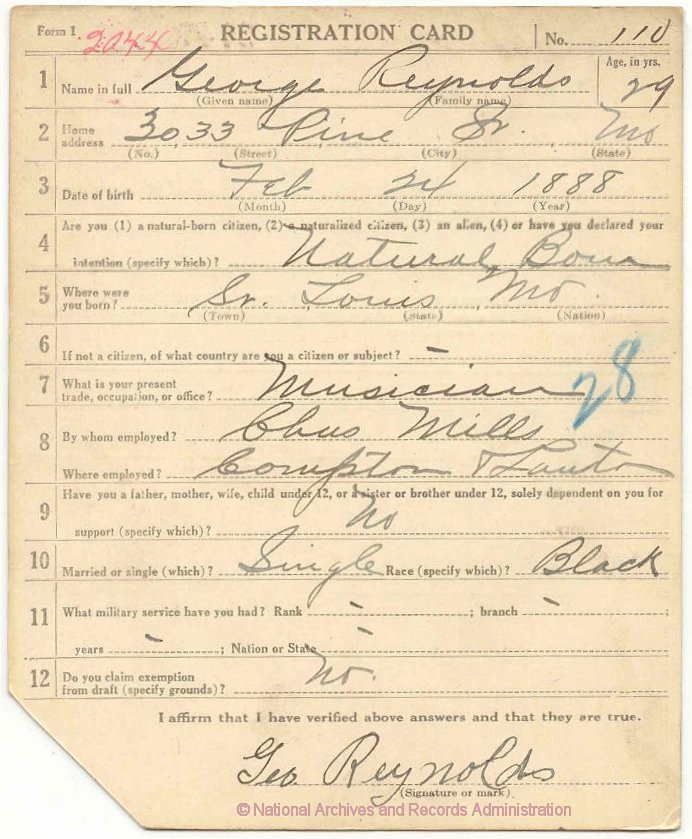
St. Louis trumpeter Dewey Jackson employed Walter Farrington in his four piece band at “Jazzland” in the early 1920s. “Jazzland” was a dance hall in the 2200 block on Market Street and was operated by the famous ragtime composer Tom Turpin. [TJR 8]  Farrington also led his own band on at least one occasion. Drummer Harry Dial, who grew up in St. Louis and was based there for most of the 1920s, recalled that he and trumpeter Shirley Clay had worked for the pianist. The engagement was at a cabaret in the Almanac Hotel, located at 14th Street and Locust Avenue, St. Louis. He mentions that Farrington was an “ear” player, and adds that this was the case with most of the other St. Louis ragtime pianists of his time, including George Reynolds, who was also recalled by Morton. Clay left for Chicago before this engagement ended, but unfortunately for Dial and the remaining musicians, they lost the hotel job because Farrington got into a fight with one of the customers and the boss fired him. [AJJ 15-16]

There is no evidence that Walter Farrington made any recordings. He did appear on radio however, as evidenced by the following item from the St. Louis Argus, dated 27th March 1931, which mentions Walter Farrington and Harvey Lankford, the well-known St. Louis trombonist and bandleader:

Musician’s Chatterbox

Marcellus Sherrod and Walter Farrington, WIL Radio Artists, will augment the program of dance music offered by Harvey Lankford and his Synco High Hatters at the People’s Finance Ballroom Saturday Night, April 4. ‘The Royal Beau Brummels’, a popular social club, is sponsoring the affair. [SLA]  [BG 7]

© December 2007 Brian Goggin


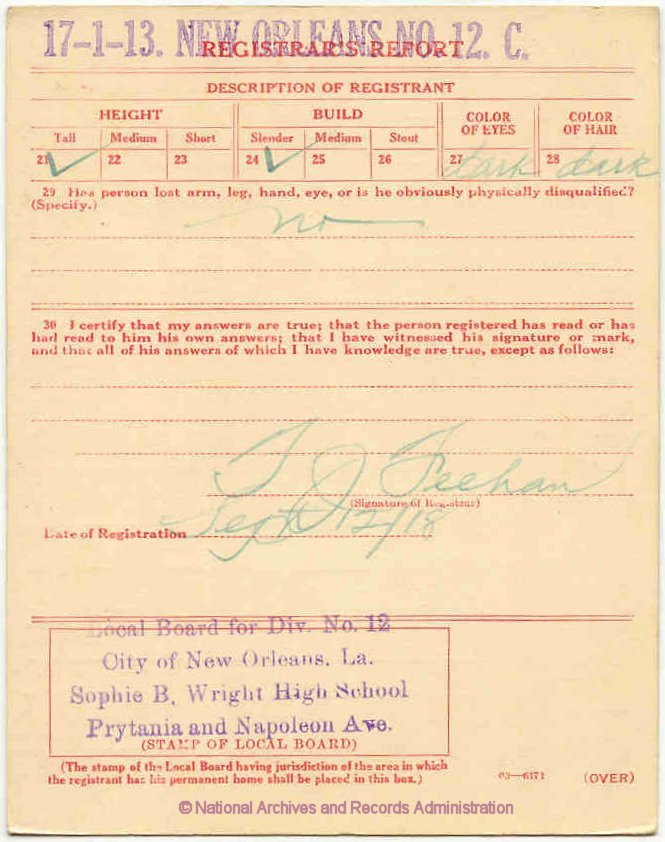
BEN FRENCH

Click to enlarge front of WWI Draft Registration Card         Click to enlarge back of WWI Draft Registration Card

Ben French

WWI Draft Registration Card
12th September 1918

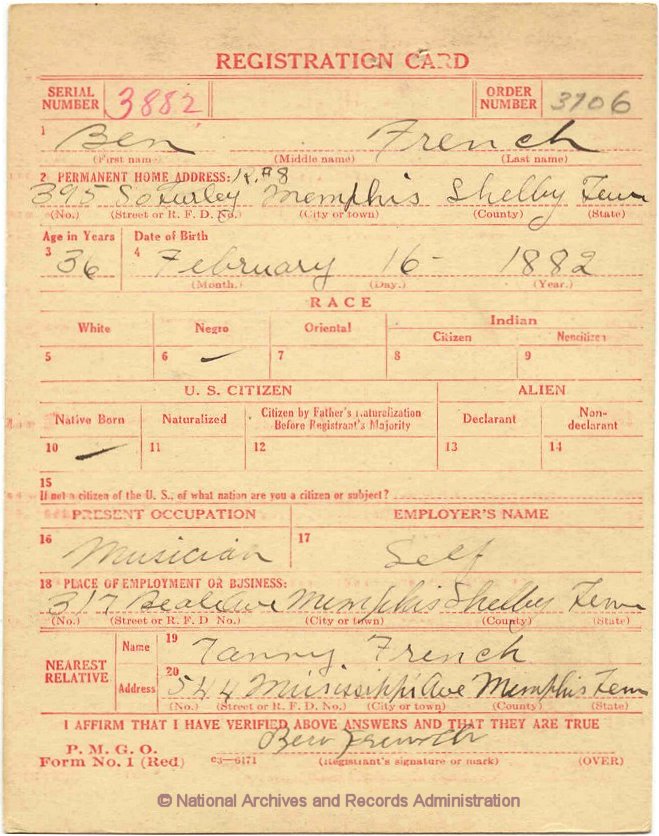
One of the many fascinating stories Jelly Roll Morton narrated on the Library of Congress recordings was about his travels with a would-be tough man from Jackson, the capital of Mississippi, who went by the name of Jack the Bear. Jelly Roll said that he “first went to Memphis around nineteen eight, possibly the earliest part of the year.” [1664-B]  However, it was probably, on the basis of the information presented below, the early part of 1911. Starting from Jackson, the unlikely pair moved on to the Mississippi towns of Yazoo, then to Clarksdale where they tried peddling a consumption cure made of Coca Cola and salt, [1665-A] and on to Helena, Arkansas to board The Natchez for their ultimate destination upriver, Memphis, Tennessee. [1665-B]

Jelly Roll and Jack gravitated towards Beale Street, called the Main Street of Black America and one of the toughest places in the whole South, and ended up in the Monarch Club, like lambs to the slaughter, for their confrontation with Bad Sam, the toughest man in Memphis who ran the dice game and acted as bouncer, and Benny Frenchy, the best pianist in the whole state of Tennessee. [1666-A]  In the event, Jelly Roll easily overcame Benny’s playing, which he imitated in an exaggerated fashion for the record, with one of his hot stomps and brought the house down singing and playing a sentimental song [1666-B] called All That I Ask Is Love (words by Edgar Selden, music by Herbert Ingraham) published in 1910. Jack the Bear, however, quickly disappeared from the scene.

Benny Frenchy was, in reality, Ben (or Benny) French, and we were able to locate his World War I Draft Card together with census records from 1920 and 1930 which list his occupation as a musician, and leave no doubt whatsoever that he was the pianist at the Monarch. According to the draft card, Ben was born on 16th February 1882, and was, like Jelly Roll and Sam Davis, tall and slender. The entry for him in the 1920 U.S. Census at 395 South Turley Street, Memphis indicates that he was a mulatto, born in Tennessee. His age in both the 1920 U.S. Census and the 1930 U.S. Census is consistent with a birth year of 1882.

That Ben French was well known as a pianist in Memphis is attested by W. C. Handy. In his fine autobiography, Handy notated French’s style of playing, and wrote, under the heading “At the Monarch”:

“The following style of piano playing, by Benny French and Sonny Butts at the Monarch on Beale Street, was my source of inspiration for the treatment given in the piano copies of Beale Street Blues, Yellow Dog Blues, and a few others. The style is theirs; the tune is mine.”
[FOB 152]

Handy gave a further example of French’s influence in the introduction and verse of his 1917 publication of Beale Street Blues. [FOB 155] The correct name of Beale Street was actually “Beale Avenue” which was written on the draft card as the location of Benny’s place of employment (317 Beale Avenue), although it was almost universally referred to as Beale Street, apart from entries in census and other official records.

The official name of the Monarch was the Monarch Club. Jelly Roll referred to it on the Library of Congress recordings as the Monarch saloon (note the lower case “s”), because that is what it was. To my knowledge, the word “saloon” never formed part of the name of the place, and this is borne out by Handy’s reference to it above and other references by Jelly Roll himself. The Monarch was built by Jim (James) Kinnane in 1910 at a cost of $20,000 and was located at 340 Beale Street. It was considered the finest gambling parlour in the South with its mirror-walled lobby and fine décor. Kinnane, born in Memphis in 1867 of Irish immigrant parents, was known as the “Czar of the Memphis Underworld,” and owned a string of gambling joints in the Beale Street precinct. It was said the Monarch was fitted with trap doors and secret exits, in case of a police raid. However, it is doubtful if these emergency exits were often used, for Jim’s sister, Josephine, was married to John Brennan, for many years a captain on the Memphis police force. Jim Kinnane told the census-taker in 1910 that his occupation was a self-employed capitalist, one of many unusual occupations recorded in census records. Although he owned the Monarch, it appears that it was managed by another tough Irishman, Mike Haggerty.

The name of Jim Kinnane has been immortalised by several blues singers: Memphis Minnie in her 1930 RCA recording of Four Women Blues, “Mississippi” Joe Callicot and also Walter “Furry” Lewis in the topical Lost My Money in Jim Kinnane’s, and Robert Wilkins, who gave up the blues life after his experiences on Beale Street to become a minister of religion, in his Old Jim Canan’s (a phonetic spelling of the name).

The end of Bad Sam was documented by a most unlikely source, an English Army Major who visited Memphis and Beale Street in 1937. The Major was escorted on a guided tour of Beale Street by a large and friendly police officer who had witnessed the violent scenes of many of the Beale Street gambling dens. When they visited the Monarch, the police officer recounted the story of Bad Sam who had been a bouncer at the club for many years. It was a rule of the club that no fighting was allowed under any circumstances. In a gambling dispute, Bad Sam knocked another man down, and the manager, presumably Mike Haggerty, shot Sam, who drew his pistol and fired back. Neither of them survived the incident.
[CEM 123]

As for Benny French, he continued on in the music world in the Beale Street precinct of Memphis, not as a soloist, but as a pianist in an orchestra, according to both the 1920 and the 1930 U.S. Census. The memory of Bad Sam and Benny Frenchy was perpetuated by Jelly Roll’s narrative for the Library of Congress, but also helped by The Record Changer magazine, which for a time featured three guest columnists commenting on current events in the jazz world, each writing under a pseudonym drawn from the characters in the Library of Congress recordings, with an appropriate cartoon image at the beginning of each column: Bad Sam, Benny Frenchy and Aaron Harris. [PH 30]

© March 2008 Peter Hanley


MINOR HALL

Click to enlarge front of WWI Draft Registration Card         Click to enlarge back of WWI Draft Registration Card

Minor Hall

WWI Draft Registration Card
5th June 1918

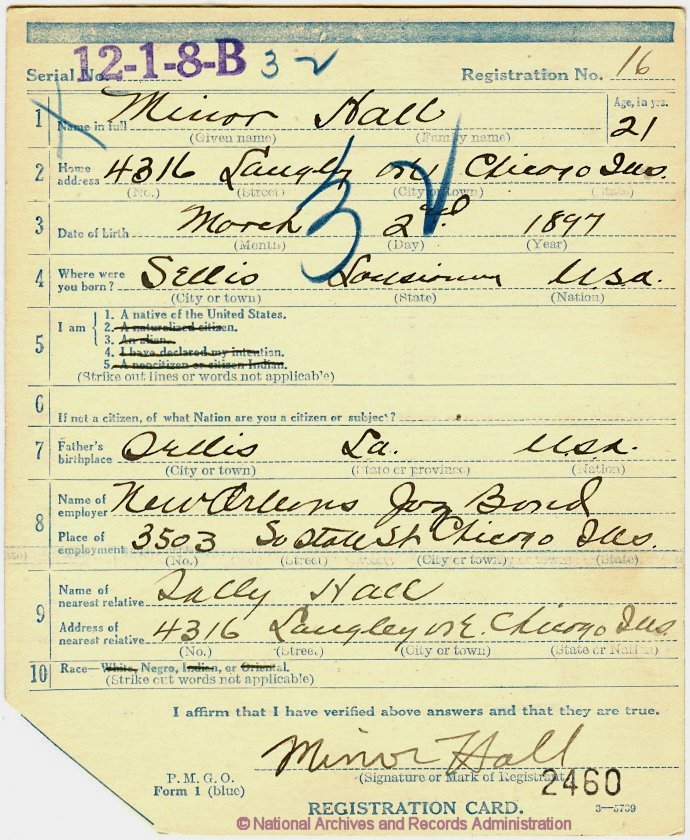
Minor Hall played a distinctive style on the drums. He was a key component of the “Ory rhythm” sound that characterized Kid Ory’s best bands.

He was born in Sellers, Louisiana on 2nd March 1897. (Note that on the draft card, the birthplace is listed as “Sellis.” The registrar may well have misunderstood Hall’s accent). An older brother, Alfred (“Tubby”), was born in Sellers in 1895. The Halls’ hometown was located in an area of St. Charles Parish where logging was a major industry. Father Joseph Hall worked as a teamster in a lumber mill located near Sellers, until he moved the family to New Orleans in the early 1900s.

Though Alfred gave Minor his first pair of drumsticks, he was quick to point out that his older brother was not an influence on his drumming! In New Orleans, Minor listened to veterans such as Henry Zeno and “Old Man” Louis Cottrell. He played his first professional job in 1914, as a substitute for Alfred. In 1916 he worked with Kid Ory’s band for the first time, filling in for Henry Martin. Hall said that Ory “told me how to play the same rhythm that Henry Martin played, so whenever Martin couldn’t play, I would substitute for him.” He also recalled Martin as “the best rhythm drummer I ever heard and he influenced me more than anyone else.”

As early as 1916, Ory was developing a unique band style that would be heard around the world during the Traditional Jazz Revival. Hall recalled the band’s repertoire: “(Ory’s) tunes were all swingy — he had that low soft, swing style and people liked it better than a loud style.” During this period, Hall was dubbed “Ram” by Ory. The nickname stayed with him for the rest of his life.

Hall made a quick trip to Chicago in 1916, to investigate the musical scene. However, he “got cold feet” and returned to New Orleans. Alfred relocated to Chicago in 1917, to play with The New Orleans Jazz Band at the Deluxe Café. Soon after, the Hall family relocated to Chicago. When Alfred was drafted, Minor took his place with the band.

The draft card, from 5th June 1918, lists Hall’s address as 4316 Langley N.E., Chicago. (Note this is also the address of his “nearest relative,” Sally Hall; his mother). His place of employment is shown as 3503 S. State Street, Chicago — the address of the De Luxe Café. At this time, the New Orleans Jazz Band consisted of “Sugar Johnny” Smith, cornet; Roy Palmer, trombone; Lawrence Duhé, clarinet; Lil Hardin, piano; Wellman Braud, bass; and Hall on drums.

During this engagement he was drafted, and served two years in the U.S. Army. When Hall returned to Chicago, he continued to work with the New Orleans Jazz Band at the De Luxe Café, and later at the Dreamland and Pekin Cafés. After “Sugar Johnny” died from the effects of tuberculosis, he was replaced by Thomas “Papa Mutt” Carey, then by Joe “King” Oliver.

In 1921, Oliver took a band to San Francisco, California for an engagement at the Pergola Dance Pavilion. (The famous photo of Oliver’s band playing on the street, dressed in work clothes, was taken at this time). During the stint at the Pergola, Oliver fired violinist Jimmy Palao. Earlier, Minor Hall threatened to leave if Palao was fired, so he left the band — to be replaced by Baby Dodds.

Hall returned to Chicago, where he worked with Jimmie Noone and exchanged ideas with the great drummer/percussionist Jimmy Bertrand. (Hall said that he taught “New Orleans Rhythm” to Bertrand in exchange for lessons on how to read music).

In 1927, Hall relocated in Los Angeles. He played with Mutt Carey’s Jeffersonians, performed “atmosphere music” on the sets of silent films and settled in for a long stint with the Winslow Allen group. He was still playing with Allen when World War II erupted. Improbably, Hall was drafted — at the age of 45! After a short hitch in the Army, he received an honorable discharge, due to his age. Then Hall went to work in a defense industry job at Douglas Aircraft.

In 1945 he rejoined his old friend, Kid Ory, when the latter came out of retirement to lead a band. Ory’s mid-‘40s band was truly an all-star line-up: Papa Mutt Carey, trumpet; Darnell Howard, Albert Nicholas, Barney Bigard or Joe Darensbourg, clarinet; Buster Wilson, piano; Bud Scott, guitar; Ed Garland, bass; Ory, trombone and Hall on drums. The rhythm section was evenly matched with the magnificent front line. The piano, guitar, bass and drums worked together like a finely-tuned engine, swinging effortlessly and providing non-stop inspiration to everyone who heard it and played with it. Ory’s rhythm section was the traditional jazz equivalent of Count Basie’s!

Besides working with Ory, Minor Hall also recorded with Louis Armstrong, Burt Bales, George Bruns and Wally Rose and he played frequently with the Firehouse Five Plus Two. He may be seen with Ory in the film “Mahogany Magic,” released in 1950 and “The Benny Goodman Story,” from 1955.

Throughout the ‘50s Hall continued to play with Ory at the Beverly Cavern in Los Angeles and Club Hangover in San Francisco. The band recorded extensively for Good Time Jazz from 1953-56, and as recording techniques improved, Hall’s drumming could be heard to excellent advantage. He usually played a supple 4/4 beat on the bass drum and used cymbals and hi-hats sparingly. Frequently he played nothing but press rolls, varying the dynamics according to the ensemble or soloist. When he switched to afterbeat rimshots on Ory’s solos, the effect was like jet propulsion.

The 1956 trio/quartet recordings with pianist Don Ewell feature exceptionally well-recorded drumming, which is superb throughout all the sessions.

When Kid Ory’s Creole Jazz Band toured Europe that same year, Hall was present when the band was filmed for the documentary “Tailgate Man From New Orleans.” Soon after he became ill and returned to Los Angeles. He never worked with Ory again, but did play with a variety of Southern California bands. He died of cancer in Los Angeles, California on 16th October 1959.
(California Death Index, 1940-1997)

Minor Hall was a swinging stylist. Thankfully there are many recorded examples of his uncompromisingly musical drumming. [HS 5]

© October 2008 Hal Smith

Special thanks to Sue Fischer for assistance with research concerning Minor Hall’s birthplace, and to Brian Goggin for assistance with research about the Hall family. Previously, the author wrote about Minor Hall for the July-August 2001 JAZZ RAMBLER, published by America’s Finest City Dixieland Jazz Society, San Diego, California.

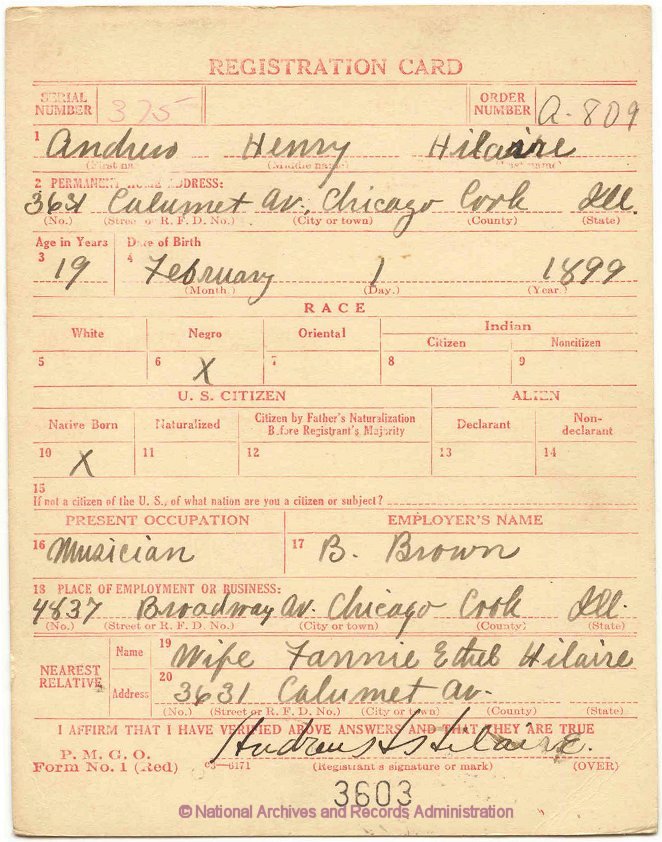
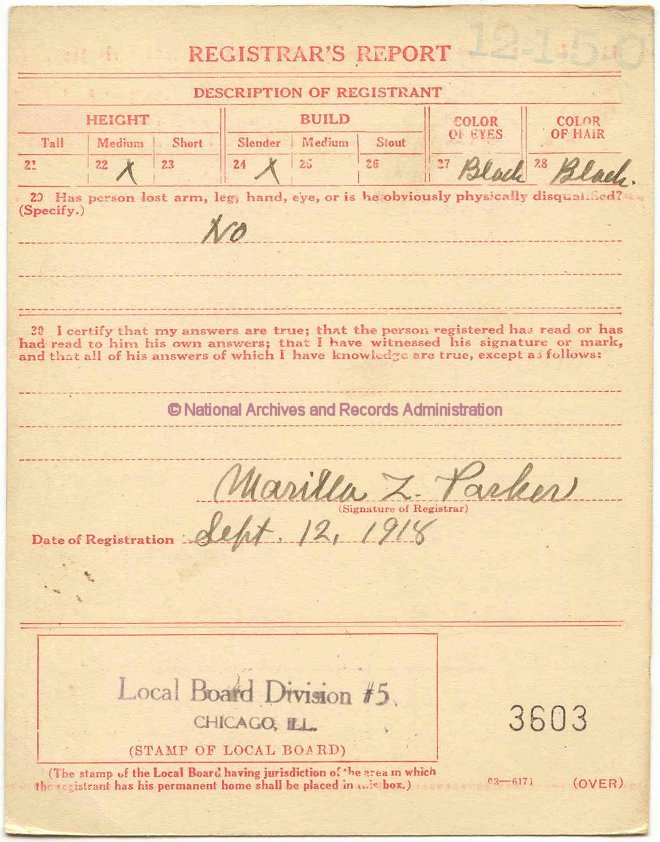
ANDREW HENRY HILAIRE

Click to enlarge front of WWI Draft Registration Card         Click to enlarge back of WWI Draft Registration Card

Andrew Henry Hilaire

WWI Draft Registration Card
12th September 1918

Andrew Hilaire only played on a few recordings, but they easily support the view that he was one of the greatest drummers in the history of jazz. Unfortunately, his biographical information is just as scarce as the recordings . . .

Andrew Henry Hilaire was born in New Orleans on 1st February 1899 to Joseph and Julia Comes Hilaire. Two more children were born to the couple: a son (Joseph) and daughter (Estelle). The family moved to Chicago sometime after 1910 (the 1910 U.S. Census shows the family still living in New Orleans). According to Andrew Hilaire’s obituary in The Chicago Defender, dated Saturday, 24th August 1935, “His education, both formal and musical was completed in Chicago.”
[CD 24835]

He married Fannie Ethel Boyer (also a Louisiana native) in nearby Lake County, Indiana on 5th August 1918. The couple lived at 3631 Calumet Ave., on Chicago’s South Side.

Jazz author John Chilton states that Hilaire “suffered from chronic asthma.”
[WWJ 147] That could easily have kept him from being called up for military service. Still, he registered for the draft in Chicago on 12th September 1918.

His occupation is listed as “musician” on the draft card. Place of employment was an unnamed venue on the north side: 4837 Broadway Avenue (between Gunnison and Lawrence) and the employer is listed as “B. Brown.” Research into the employer’s full name and the name of the club has not yielded any results. However, jazz historian Sue Fischer mentioned that some Chicago street numbers were changed in 1919. Thus, it is possible that Hilaire was performing at the Green Mill Gardens (4806 Broadway), Uptown Village (#4822) or the Arcadia Ballroom (#4444). In Who’s Who of Jazz, Chilton states that Hilaire worked with vocalist Florence Mills.
[WWJ 147] She was based in Chicago from 1916-1919. It is possible that he was working with the singer in a club owned by “B. Brown.”

In the early 1920s Hilaire worked with a band led by pianist Lil Hardin, then joined the orchestra led by Charles “Doc” Cook at the Dreamland Café in Chicago circa 1924. Here, he worked alongside such jazz giants as Freddie Keppard, Jimmie Noone and Johnny St. Cyr. His first recordings with Cook were made on 22nd June 1926 with “Cookie’s Gingersnaps” — a septet drawn from the large orchestra. On these records, as well as the sides with the full orchestra, it is not always possible to hear the drums throughout the entire performance. However, the perfectly timed cymbal crashes, woodblock rhythms and choke cymbal on the rideout choruses prove that Hilaire was a genuine musical drummer.

His most famous records were made in September and December of 1926 — with Jelly Roll Morton’s Red Hot Peppers.
[RHP] The drumming on these recordings is the embodiment of Morton’s philosophy: “Sweet, soft, plenty rhythm, plenty swing.” There is so much to savor in Hilaire’s playing . . . a wonderful 4/4 pulse on the bass drum and dancing rhythms played on the bass drum shell (“Doctor Jazz” and “Grandpa’s Spells”); hot choke cymbal (“Steamboat Stomp”); afterbeats on the tom-tom (or a snare drum with the snares turned off) on the rideout choruses of “Black Bottom Stomp” and “Sidewalk Blues” and the revolutionary sounds — for 1926 — of jazz brushes swinging the Red Hot Peppers softly, but firmly, on “Steamboat Stomp” and “Grandpa’s Spells.”

Hilaire recorded only a few more sides after the Red Hot Peppers session of 16th December 1926. Between June 1927 and March 1928, he made three more recording dates with Doc Cook (also contributing distinctive vocals on “Willie The Weeper” and “I Got Worry”). After leaving Cook’s orchestra, he worked with theater orchestras around Chicago, taught drums and vibraphone and played brief stints with bands led by Jerome Don Pasquall and Eddie South. He also led his own orchestras, including one that performed at the Indiana Theater.

The headline of his obituary, published in The Chicago Defender, dated Saturday, 24th August 1935 reads, “A.H. Hilaire, Orchestra Leader, Dies.”
[CD 24835] He died at his home, 4008 Calumet Avenue, Chicago on Saturday, 3rd August 1935.

Years after the Red Hot Peppers recordings were issued, drummer George Wettling recalled Andrew Hilaire as one of the greatest drummers in Chicago. Bill Dart, the drummer with Lu Watters’ Yerba Buena Jazz Band, proclaimed Hilaire “a wizard” based on the Morton sides. Contemporary CD reissues of the 1926 Morton recordings allow us to hear the drums more clearly than ever, and there can be no doubt that Wettling and Dart were not exaggerating!
[HS 3]

Special thanks to Prof. Alan Wallace, Brian Goggin, John Chilton and Sue Fischer for their research assistance.

© March 2008 Hal Smith

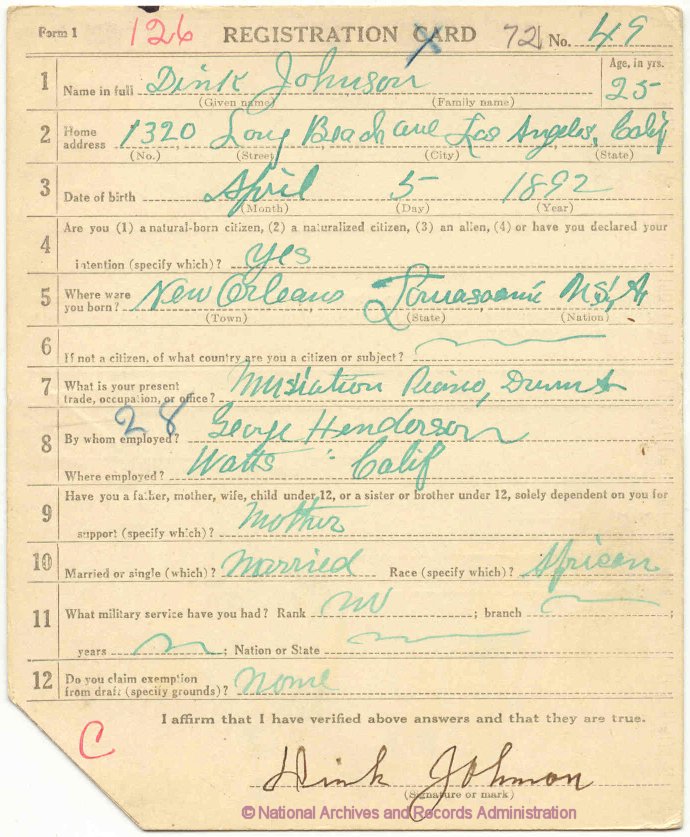
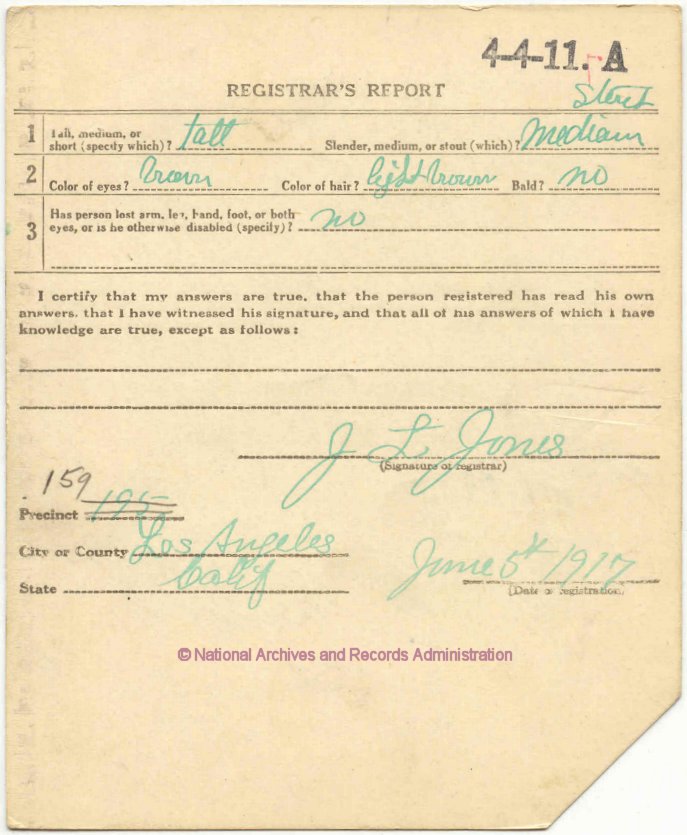
DINK JOHNSON

Click to enlarge front of WWI Draft Registration Card         Click to enlarge back of WWI Draft Registration Card

Dink Johnson

WWI Draft Registration Card
5th June 1917

Dink Johnson was the youngest brother of Anita Gonzales Ford (Bessie Johnson), the woman Jelly Roll Morton referred to as his wife, although there is no evidence they were ever married. Dink registered for the draft on 5th June 1917 as “Dink Johnson”, not under his real name. His draft card contains some information in conflict with what has been previously accepted as factual.

The card confirms that he was born in New Orleans, not in Biloxi, Mississippi, which has usually been given as his birthplace. Born Ollie Johnson, he was the youngest of seven children of Hattie Johnson from several fathers. It is not know for certain who Dink’s father was, but an obituary in the 1st December 1954 issue of the Oregon Journal of Portland, based on information supplied by his brother, David Tunney Johnson, claimed that he was the son of a New Orleans undertaker, unnamed in the article.

The date of birth given for Dink is 28th October 1892, based on another obituary in a Santa Barbara, California newspaper. The draft card, however, records a date of birth of 5th April 1892, while the entry for the Johnson family in Biloxi, Mississippi in the 1900 U.S. Census has January 1892.

Dink left Biloxi in 1911 or 1912 to help his sister, Anita, at the Arcade Saloon, which she was running in the then frontier town of Las Vegas. So far as we know, his professional career in music began in Los Angeles when he was the drummer for a short period of time in the Creole Band, which had been organised by his eldest brother, Bill Johnson. Dink did not tour with the Creole Band, but stayed around Los Angeles where he later played in bands with Jelly Roll, his friend and “brother-in-law”. Although he played drums in this early period, Dink had played piano from his teenage years, and it is as a fine and unique pianist that jazz history views him.

When Ory’s Sunshine Orchestra (also called Spikes’ Seven Pods of Pepper), recorded in Los Angeles in June 1922, Dink played clarinet. It was said that he stomped his feet so loudly, the recording engineer had to put a small mattress under his feet so the recording session could proceed.

During the 1940s, Dink ran a bar and restaurant called Dink’s Place at 4229 Avalon Boulevard, Los Angeles. The jazz historian, William Russell, recorded Dink’s piano playing and blues singing in Los Angeles in March 1946 and October 1947 for his American Music label (later bought by George H. Buck Jr. who reissued the 12 tracks recorded on American Music CD AMCD11 in 1993). Private tapes were also recorded in November 1950, and issued by Paul Affeldt on Euphonic LPs (15 tracks reissued with 3 previously unissued tracks on Delmark CD 646). These tracks amply prove what a good pianist he was. He also wrote a few fine piano works including Frisco Dreams (Stella Blues), Stomp de Lowdown and So Different Blues.

Plagued by alcoholism in his later years, Dink died in Portland, Oregon on 29 November 1954.
[PH 17]

© May 2007 Peter Hanley

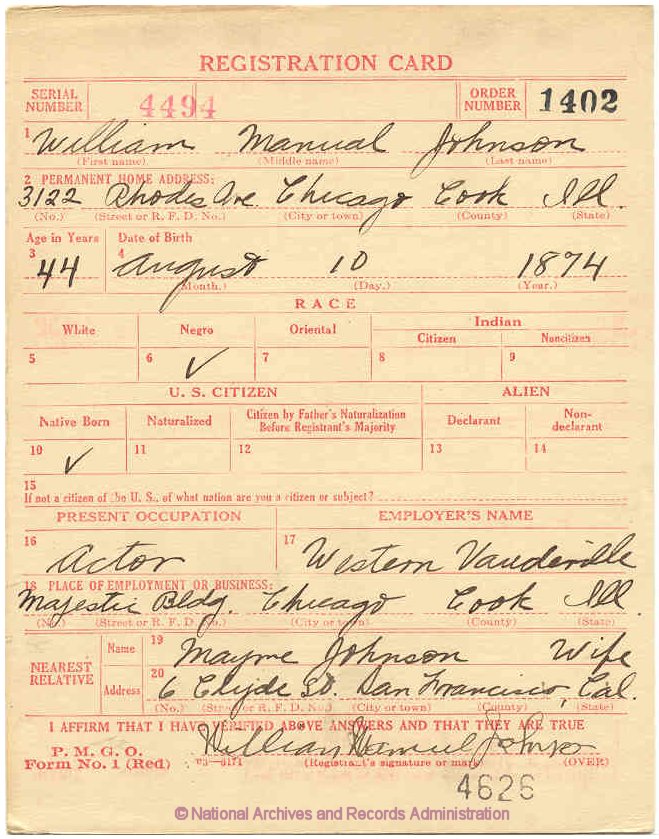
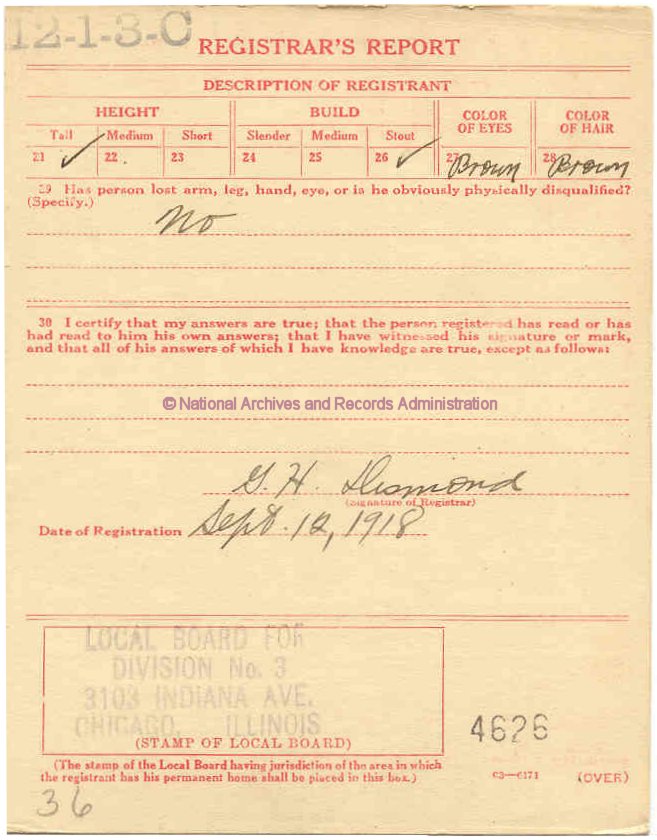
WILLIAM MANUEL JOHNSON

Click to enlarge front of WWI Draft Registration Card         Click to enlarge back of WWI Draft Registration Card

William Manuel Johnson

WWI Draft Registration Card
12th September 1918

William Manuel (Bill) Johnson was one of the earliest jazz musicians, and his career as a musician began in the late 1880s and extended to the 1950s. Although the registering officer at the draft board wrote his middle name as “Manual”, Bill clearly signed the card as “William Manuel Johnson”. A fine guitar and banjo player, he was better known as a pioneering string bass player, perhaps the best of the golden period of the 1920s. Historically, Bill Johnson is remembered as the organiser and manager of the Creole Band, the first band to take jazz across the United States and into Canada on their many tours, in the period from 1914 to the early part of 1918. For a detailed history of the band, our readers should read Prof. Lawrence Gushee’s fine book, Pioneers of Jazz: The Story of the Creole Band. [SCB]

When he registered for the draft at Local Board No. 3 in Chicago on 12th September 1918, Bill gave his date of birth as 10th August 1874, which confirms the details for his birth year recorded in the 1880 U.S. Census in the entry for the Johnson family in Montgomery, Alabama. Other birth dates on census records, 1876, 1879 and 1882, and the date on his death certificate (1872) would appear to be incorrect. Bill was recorded in the 1880 census as “Willie White”, the son of Hattie Johnson, a quadroon formerly known as Hattie White. In interviews in the 1950s, he said that he was born in Talledega, Alabama and was the son of a well-known and respected white man. The many photographs of Johnson show that he was tall and heavily built, and very light in colour. There is no doubt that he could have passed as white, but he declared on the draft card that his race was “Negro”.

Jelly Roll Morton’s common law wife from 1917 to 1922, Anita Gonzales (Bessie Johnson), was Bill Johnson’s half-sister.
[MMJ] There was a close and continuing friendship between Jelly Roll, Bill, and his youngest half-brother, Dink. Jelly Roll played a brilliant interpretation of Bill’s rhythmic style on bass for the Library of Congress recordings in The Salty Dog. [AFS 1652-A]

After the demise of the Creole Band in 1918, Johnson made Chicago his headquarters and, in the period from 1923 to 1930, played on many recordings made by King Oliver, Johnny Dodds, Junie Cobb, State Street Ramblers and Tampa Red. The Johnny Dodds sessions for Victor in July 1928, January 1929 and February 1929 are superbly played and recorded, with some fine examples of Bill’s playing. It seems strange that Jelly Roll did not use Bill on his June 1927 Chicago session for Victor.

Bill’s career went into decline in the 1930s, although he became something of a historical figure, supplying much information to Charles Edward Smith, Frederic Ramsey Jr. and William Russell for Jazzmen, their historic 1939 publication. Although based in Chicago until the l950s, he moved permanently to Texas with frequent trips to Mexico, living in self-imposed obscurity. Bill Johnson died in New Braunfels, Texas on 3rd December 1972 at the grand age of 98.
[PH 18]

© June 2007 Peter Hanley

WILLIE JOHNSON

Click to enlarge front of WWI Draft Registration Card         Click to enlarge back of WWI Draft Registration Card

Willie Johnson

WWI Draft Registration Card
12th September 1918

Willie Geary (Bunk) Johnson was certainly a travelling man. After he left New Orleans permanently about 1914, he was incessantly on the move, establishing a base in New Iberia only in 1928 when he commenced to live with Maude Balque. Bunk was known to have played at various times in the Louisiana towns of Alexandria, Baton Rouge, Bogalusa, Crowley, Madisonvillle and Mandeville; he played in Beaumont, Dallas, Electra, Houston, and Port Arthur in Texas; and he claimed that he was in bands in Chicago, Kansas City, Montana, San Francisco and West Virginia.

Bunk also claimed he had travelled to Europe, England, the East, and even to Australia. Whether this was true or not, he was in Lake Charles, in western Louisiana when Uncle Sam caught up with him to register for the World War I Draft. At the time, he was working in the band of the drummer, Paul Jones.

Never one to concern himself with facts, Bunk gave his age as 36, and his birth date as 27th December 1882 on the draft card, which was registered on 12th September 1918. This is the sixth different birth date given by him, which we have found on the public record. Interestingly, he gave his height as medium and 5 feet 7 inches on the card, although his photographs from the 1940s with members of his New Orleans Band indicate that he was not that much shorter than Jim Robinson, a very tall man.

All this adds to the reason it has been so difficult for researchers to find accurate information about him. Bunk just did not seem to care. His claims were legion. The postscript to the “portrait” of him gathers together all the documentary evidence that is likely to be discovered — except for his Certificate of Baptism. Can any of our New Orleans friends help us to find the certificate?
 [PH 9]

© February 2007 Peter Hanley

RICHARD JONES

Click to enlarge front of WWI Draft Registration Card         Click to enlarge back of WWI Draft Registration Card

Richard Jones

WWI Draft Registration Card
5th June 1917

At the time of his death in 1945, Richard Jones was described as the ‘forgotten man of jazz’ but, happily, he is now remembered and admired for his achievements as a composer, pianist/bandleader and record producer. His compositions include such classics as 29th and Dearborn, Heebie Jeebie(s), Jazzin’ Babies Blues and Trouble In Mind and his small-group recordings, usually under the name Richard M. Jones’ Jazz Wizards, set both the format and the standard for ‘south-side’ Chicago jazz. Although his piano playing is now usually described as “competent”, the people he played with include Louis Armstrong, Shirley Clay, Johnny Dodds, Preston Jackson, Dave Nelson, Albert Nicholas, Jimmie Noone, King Oliver, Roy Palmer, Luis Russell, Bud Scott, Omer Simeon and Johnny St. Cyr. As a record producer he brought King Oliver to the attention of Gennett and Ma Rainey to the attention of Paramount. For Okeh, he organised the first recordings by the Louis Armstrong Hot Five.

For jazz enthusiasts, Jones is always Richard M Jones and that middle initial has been the subject of many a discussion. That it stands for ‘Myknee’, and literally refers to Jones’ knee, has been accepted for some time and the Draft Registration Card both supports this and gives us more information on what may have been wrong with Jones’ knee. Albert Nicholas and Preston Jackson thought that Jones had a chronically stiff leg and remembered his complaint of “Oh! My knee, my knee, my knee!”; Pops Foster thought that Jones had a wooden leg.
[RMJ]  On the basis of the Registration Card information we can conclude that it was the left leg that was the problem and that the ‘stiff leg’ option is preferable to the artificial leg option.

The Card confirms Jones’ birthplace (Donaldsonville, south of Baton Rouge, Louisiana) and gives a birth date (13 June 1889), which is different to that shown on his death certificate (12 June 1892). At various times Jones gave both 1889 and 1892 as the year of his birth. Jones’ address in 1917 was South Liberty Street, New Orleans — i.e. ‘Uptown’. He may not have been doing too well in New Orleans in 1917, as suggested by the employment description of ‘unemployed musician’.

Jones moved to Chicago c. 1918 and established his own music store — filling the gap left by Clarence Williams’ departure for New York in late 1919/early 1920. At that time he adopted the full name Richard M. Jones and even used ‘Mariney’ (a variant of ‘Myknee’) as his middle name. In 1923 he became local manager of the ‘race’ division of the General Phonograph Corporation (Okeh records) and in this position had a powerful and lasting influence on the recording of classic jazz.
  [AC 1]

© February 2007 Anton Crouch

MAX KORTLANDER

Click to enlarge front of WWI Draft Registration Card         Click to enlarge back of WWI Draft Registration Card

Max Kortlander

WWI Draft Registration Card
5th June 1917

Max Kortlander (1890-1961) was an important figure in the QRS piano roll company. An excellent pianist, he had joined the company in 1914 progressing to become manager of the Recording Department. As a songwriter, he had scored a big success in 1918 with “Tell Me,” which was recorded by Al Jolson among others. It is said that the sale of this song to the Remick publishing firm was the basis of Kortlander’s fortune.

According to his late daughter, Jean Elizabeth Kortlander, Max was a rare combination of musician and businessman, and these combined skills made it possible for him to acquire and run the company when the previous owner went bankrupt.

It should be noted that when Max became President of QRS in the 1930s he no longer made any of the rolls listed as played by him — J. Lawrence Cook produced them.
[BR]

Two versions of Max Kortlander’s date of birth exist in The Billings Rollography — one (page 194, Vol. 3 and again at page 232, Vol. 5) says that it is September 1st 1890 — while the other (page 10, Vol. 5) claims that he was born in 1891, which agrees with his draft registration card. [JF 2]  However, during a personal visit by Bill Burkhardt to Kent County, Michigan records office he discovered that Max Kortlander’s date of birth was registered (in book 8, page 228) as September 1, 1890, which must be regarded as conclusive evidence of Max’s true birth date. Perhaps it will never be known why 1891 was inscribed on the draft registration card. [JF 3]

© November 2006 John Farrell


THOMAS JAMES LADNIER

Click to enlarge front of WWI Draft Registration Card         Click to enlarge back of WWI Draft Registration Card

Thomas James Ladnier

WWI Draft Registration Card
12th September 1918

According to his WWI draft card, Thomas James Ladnier lived in Chicago and was employed as a labourer with Armour & Co., which was one of the largest meatpacking companies in the U.S.A. For many years, along with a handful of other companies, Armour helped to make Chicago’s Union Stockyards the centre of the meat industry in the country. Ladnier’s 1925 passport application and ship passenger lists from trips between Europe and New York in 1926, 1930 and 1931 support the birth date of 28th May 1900 that is shown on the draft card. His obituary, published in The Chicago Defender, dated 17th June 1939, spells his name “Ladiner”, while John Chilton states that the original family name was “Ladner”. [WWJ 191] However, Ladnier’s cousin Calvin Ladner (sic) stated that “Ladnier” was indeed the correct spelling of the name. Ladnier was almost certainly born in St. Tammany Parish, Florenville (not “Florenceville”), Louisiana, but had relatives in Biloxi, Mississippi. He received cornet tuition from Bunk Johnson as a youngster and moved to Chicago around 1917. He was primarily based there until 1925, during which time his employers included Ollie Powers, King Oliver, Fate Marable and Charlie Creath. Tommy Ladnier is generally identified by many discographers as the cornet player on Jelly Roll Morton’s earliest verified recording session in Chicago in 1923. [JRM]

In 1925, the trumpeter was requested to attend an audition by pianist and bandleader Sam Wooding, which he passed. He sailed for Europe and spent over a year there working for Wooding and later with the Louis Douglas Revue. A few months after his return to the U.S.A., following a short stint with saxophonist Billy Fowler’s orchestra, Ladnier joined Fletcher Henderson’s orchestra in New York and was the “hot” trumpet man in that band from October 1926 until November 1927. He returned to Europe with Wooding in March 1928, and subsequently, he worked with several other orchestras there. Apart from a period in New York from December 1930 until May 1931, he remained overseas until July 1931. Jelly Roll Morton clearly rated Ladnier and Sidney Bechet highly as he tried, unsuccessfully, to poach them from Noble Sissle during that New York period. [SB 87] In 1932, Ladnier and Sidney Bechet formed “The New Orleans Feetwarmers” and with plenty of whiskey and chat flowing, this band recorded a rousing, historic session on 15th September 1932. The pair had originally met in Russia in 1926 when Bechet bought a Pathé cine-camera from Ladnier and they became close friends. [SB 78]

The depression forced Bechet and Ladnier to disband and the co-leaders ran their “Southern Taylor Shop” in New York for a time afterwards, while holding music sessions there at night. According to Willie “The Lion” Smith, the shop was located in a basement at 129th St. and St. Nicholas in Harlem. Bechet usually pressed and repaired suits, while Ladnier specialized in shining shoes. [AMII 27-28] In 1934, both men were invited by Noble Sissle to rejoin his orchestra. Bechet accepted, but Ladnier did not and obscurity followed for the trumpeter until 1938, when interest was renewed in him by the French critic Hugues Pannassié. Drummer Zutty Singleton recalled that Bechet and Ladnier lived together around this time again, in the same building as himself. They called the living quarters the “House of Meditation”, where they listened to Classical Music and practised themselves. [AMII 27-28] The duo appeared in the “From Spirituals to Swing” concert in Carnegie Hall on 23rd December 1938 and the trumpeter recorded again in 1938-1939, including sessions under his own name. There were some upsets during these sessions, and on one date Ladnier and James P. Johnson both showed up “feeling no pain”. Apparently Johnson was horizontal and Ladnier, on seeing Pannassié with his head buried in his hands because of the situation, shouted “Vive la France” to try and cheer him up before almost collapsing! [TIG 68]

Sadly, by this time Tommy Ladnier’s days were numbered. On 4th June 1939, a week after his 39th birthday, he died of a heart attack while staying with reedman Milton “Mezz” Mezzrow (Mesirow) in New York. Mezzrow had left Tommy that night in the belief that he was attending a party upstairs in his apartment block but when he returned home, he found that Ladnier had died on the sofa. Ladnier had been a heavy drinker, and Mezzrow recalled that he was trying to give up this vice, but despite doctors’ orders, he had no intention of ceasing to play his horn. Mezzrow also mentioned that Ladnier’s estate consisted of just a few items of clothing. [RTB 296-299] Four days later, the “Port of Harlem Seven”, including Bechet and guitarist Teddy Bunn; recorded the poignantly titled “Blues For Tommy” for Blue Note.

Tommy Ladnier was one of the great second generation Jazz trumpeters. He was very much a King Oliver devotee and a very expressive musician. While he was a good orchestral player, Ladnier was far more focussed on being an improviser, rather than being a reader. Harry Dial recalled the trumpeter telling Fate Marable “Nobody can hear you reading.” on receiving reading instruction from the famous riverboat bandleader.
[AJJ 20] His belief on this is clearly audible if one compares his solos, for example, on the five takes of “Play That Thing” with Powers or the two takes of “Clarinet Marmalade” with Henderson (1926). Ladnier was an effective all round player. He acquitted himself well on ballads and displayed great drive and capability on stomps, as evidenced on “Hop Off”, “Rocky Mountain Blues” or “Stockholm Stomp” with Henderson or the 1932 New Orleans Feetwarmers session. However, Tommy’s forté was the blues. In this style, his playing, both open and with various mutes, was excellent, as borne out by “Play That Thing” with Powers, “The Chant” and “Snag It” with Henderson or “Really The Blues” under his own name. He could also generate the softer cup-muted sound favoured by many during the swing era, which was audible in his final sessions.

For his generation, Ladnier was exceptionally well travelled and the trumpeter could hold his own in any company. Muggsy Spanier, who was friendly with him in Chicago in the early 1920s and spent time with him again in 1930 in Paris, was a big fan. He recalled, “We spent a lot of time together, that is, when Tommy wasn’t hobnobbing with the upper crust. I’ve never seen a more popular guy with the higher ups, the Dukes and Counts and things”. Ladnier was usually mild mannered, but if he was provoked, he would not tolerate disrespect from people. Trombonist Herb Flemming recalled that during a private performance for the Spanish Royal family by Sam Wooding’s Orchestra, reedman Willie Lewis interrupted Ladnier’s featured spot, so he ceased playing and confronted him. When Wooding reprimanded them, he said, “To hell with the King and the whole . . . lot of ‘em. If he can play my solo better than I can, let ‘em. And as for that monkey over there (Lewis), you tell him stay out of my solos or else . . . ! Wooding preferred Doc Cheatham as a trumpeter, with whom he later replaced Ladnier, but he regarded Tommy as a fine storyteller and good for the morale of the band.
[HF 21-25]

Leaving the final word with Muggsy Spanier, he concluded his obituary tribute to the trumpeter with: “Take it from me, when old Gabe blows that horn one of these days, he’ll probably use the fingering that Tommy Ladnier taught him.” [BG 13]

Special thanks to Dan Vernhettes, Bo Lindström and Peter Hanley fo